
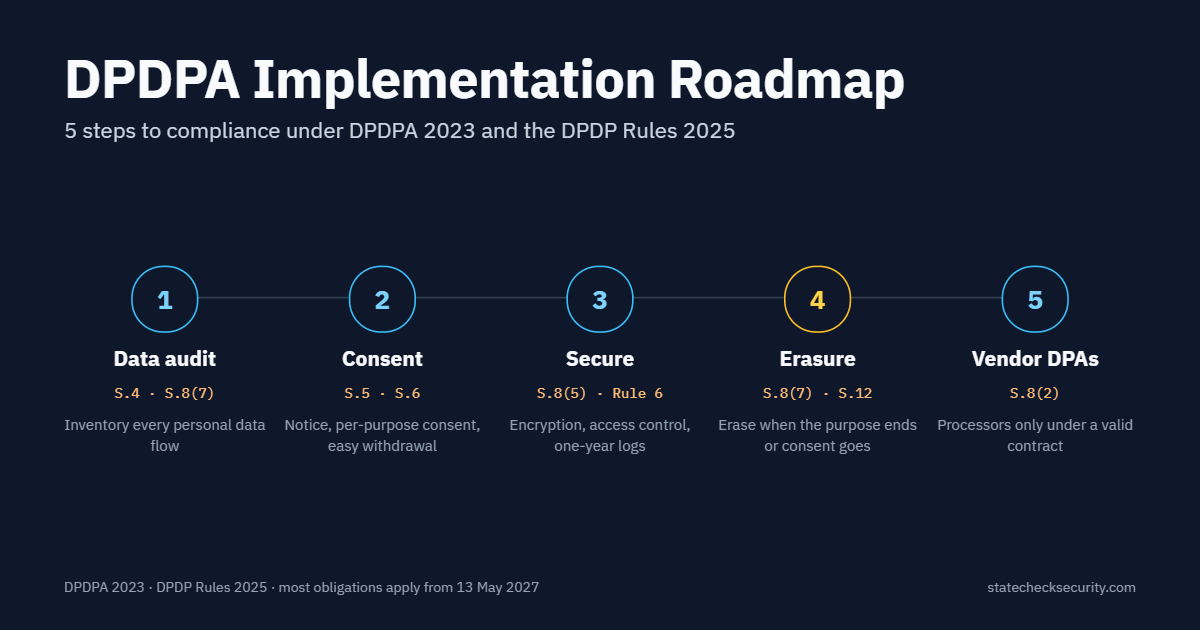
DPDPA Implementation Roadmap: 5 Steps to Compliance
Key Takeaways
- A DPDPA implementation roadmap begins with a data audit. You cannot enforce purpose limitation (Section 8(7)) or consent withdrawal on personal data you have not mapped — uncharted data is uncontrolled liability.
- Consent under Section 6 must be free, specific, informed, unconditional, and unambiguous, with a clear affirmative action. Pre-ticked checkboxes and bundled consent forms are direct violations, regardless of how detailed the Terms and Conditions are.
- "Reasonable security safeguards" under Section 8(5) is operationalised by Rule 6 of the DPDP Rules 2025, which sets a minimum: data security measures such as encryption, obfuscation, masking or virtual tokens; access control over computer resources; logs, monitoring and review of access; backups for continued processing; one-year retention of those logs and personal data; security clauses in Data Processor contracts; and technical and organisational measures to make the safeguards effective.
- The Right to Erasure under Section 8(7) is a proactive Fiduciary obligation — not just a response to a user request. When consent is withdrawn or the specified purpose is no longer being served, erasure must propagate across all systems, including backups, staging environments, and Data Processor copies (Section 8(7)(b)), subject to the one-year minimum retention of personal data and logs in Rules 6(1)(e) and 8(3).
- Every Data Processor must operate under a valid contract per Section 8(2), and Rule 6(1)(f) requires that contract to provide for reasonable security safeguards. Under Section 8(1) the Data Fiduciary remains responsible for processing done on its behalf by a processor. Vendor DPAs are a legal firewall, not an administrative formality.
- A Data Protection Officer (DPO) based in India is required only for Significant Data Fiduciaries under Section 10(2)(a) — not for all organisations. All Data Fiduciaries must establish an effective grievance redressal mechanism (Sections 8(10) and 13; responses within a period not exceeding 90 days under Rule 14(3)) and publish the business contact of a person who can answer Data Principals' questions (Section 8(9), Rule 9). These are distinct obligations.
- The DPDP Rules 2025 were notified on 13 November 2025 (G.S.R. 846(E)); the 3 January 2025 text was the draft. Commencement is phased: the Board provisions applied from 13 November 2025, Consent Manager registration applies from 13 November 2026, and the core Data Fiduciary obligations (notice, consent, security safeguards, breach intimation, retention, rights) apply from 13 May 2027. Start implementation now — that deadline is fixed.
Table of Contents
- What Does a DPDPA Implementation Roadmap Actually Cover?
- Entity Glossary
- Step 1 — DPDPA Data Audit: Building Your Personal Data Inventory
- Step 2 — Overhauling Your Consent Architecture Under Section 6
- Step 3 — Implementing Reasonable Security Safeguards (Section 8(5) and Rule 6)
- Step 4 — Engineering the Right to Erasure Under Sections 8(7) and 12
- Step 5 — Vendor Risk Management: DPDPA Compliance Checklist for Data Processors
- How Long Does DPDPA Implementation Take?
- FAQ
What Does a DPDPA Implementation Roadmap Actually Cover?
The Digital Personal Data Protection Act, 2023 (DPDPA) has officially shifted India's data privacy landscape from a policy-driven culture to a legally enforceable obligation stack. For business leaders, founders, and IT directors, reading the Act is one thing; re-engineering your organisation's data infrastructure to comply is another challenge entirely.
A DPDPA implementation roadmap translates the Act's obligations into five sequential workstreams: discovering and mapping your personal data assets; redesigning consent and notice architecture; deploying technical and organisational safeguards; engineering erasure workflows; and governing your Data Processor supply chain. Each step maps to a controlling section of the Act and a corresponding rule in the DPDP Rules 2025.
For an overview of DPDPA compliance obligations for Data Fiduciaries — including the penalty schedule and the DPDPA vs. GDPR structural differences — start with our executive compliance guide.
Entity Glossary
Data Fiduciary — Any person who determines the purpose and means of processing personal data (S.2(i)). Equivalent to 'Data Controller' under GDPR. If your business decides why and how personal data is used, you are a Data Fiduciary.
Data Principal — The individual to whom the personal data relates (S.2(j)); for a child, this includes the parents or lawful guardian. Equivalent to 'Data Subject' under GDPR.
Data Processor — Any person who processes personal data on behalf of a Data Fiduciary (S.2(k)); the engagement must be under a valid contract (S.8(2)). Every SaaS vendor, cloud host, and analytics platform that processes your users' data is a Data Processor.
Significant Data Fiduciary (SDF) — A Data Fiduciary notified by the Central Government on factors including the volume and sensitivity of personal data processed, risk to Data Principals' rights, and security of the State (S.10(1)). SDFs face additional obligations: a DPO based in India, an independent data auditor, and periodic DPIAs and audits (S.10(2)), which Rule 13(1) makes annual.
Technical and Organisational Measures (TOMs) — The minimum safeguards listed in Rule 6(1)(a)–(g): data security measures (encryption, obfuscation, masking, virtual tokens), access control, access logging and monitoring, backups, one-year log retention, processor contract clauses, and measures to make them effective. The practical implementation of the Section 8(5) security obligation.
Step 1 — DPDPA Data Audit: Building Your Personal Data Inventory
You cannot protect, limit, or delete what you do not know you have. Most organisations suffer from data sprawl — personal data accumulated across product databases, CRMs, marketing automation tools, analytics SDKs, HR systems, and shared storage.
The UrbanBites Scenario: UrbanBites is a fast-growing food delivery startup. The founders assume they collect only customer names, phone numbers, and delivery addresses. A comprehensive data audit reveals a different picture: the marketing team is storing precise user geolocation data indefinitely in a separate analytics tool; the HR department holds thousands of unencrypted job-applicant CVs on a shared Google Drive; and a third-party analytics SDK embedded in the app transmits device fingerprints to a US-based vendor — under no signed Data Processing Agreement.
Under Section 8(7), all of this uncharted data is a liability: purpose that was never defined cannot be "fulfilled," and data retained without a lawful ground violates Section 4.
Data Audit Action Items
Build a Personal Data Inventory with at minimum these fields per data asset:
{
  "data_category": "delivery_address",
  "collection_point": "checkout_api_v2",
  "purpose": "order_fulfillment",
  "lawful_ground": "consent_s6",
  "storage_system": "postgres://customer-db/orders",
  "processors": ["ShipRocket", "AWS_RDS"],
  "cross_border": false,
  "retention_days": 730,
  "retention_basis": "DPDPA_S8_7_purpose_limitation",
  "last_audited": "2026-04-01"
}
For each collection point: confirm there is a lawful ground under Section 4 (either consent per Section 6, or a legitimate use per Section 7). If a collection point has no clear lawful ground, stop or suspend that processing until the ground is established.
The data audit also populates your Processor Register — every vendor named as a processor in the inventory must have a signed Data Processing Agreement (Step 5).
Step 2 — Overhauling Your Consent Architecture Under Section 6
The era of burying data processing permissions in 40-page Terms and Conditions documents is over. Section 6 of DPDPA defines consent as: free, specific, informed, unconditional, and unambiguous, expressed through a clear affirmative action.
The CloudMetrics Scenario: CloudMetrics, a B2B SaaS company, currently uses a pre-ticked checkbox on their signup form: "I agree to the Terms, Privacy Policy, and to receive promotional offers." This is a direct Section 6 violation on three counts: the checkbox is pre-ticked (not an affirmative action), it bundles three distinct purposes into one consent, and it is not purpose-specific.
Notice Before Consent (Section 5)
Every consent request must be accompanied or preceded by a Notice stating: (i) the personal data and the purpose for which it is proposed to be processed; (ii) how the Data Principal may withdraw consent (Section 6(4)) and seek grievance redressal (Section 13); and (iii) how she may complain to the Board (Section 5(1)). The Data Principal must be given the option to access the notice in English or any language in the Eighth Schedule to the Constitution (Section 5(3)). Rule 3 adds that the notice must stand on its own and give an itemised description of the personal data.
Consent Record Schema
Each consent event must be logged immutably for audit purposes:
CREATE TABLE consent_records (
  id            UUID PRIMARY KEY DEFAULT gen_random_uuid(),
  principal_id  UUID NOT NULL,
  purpose_id    TEXT NOT NULL,          -- e.g. 'marketing_email', 'order_processing'
  granted       BOOLEAN NOT NULL,
  method        TEXT NOT NULL,          -- 'checkbox_affirmative', 'api_grant'
  ip_address    INET,
  user_agent    TEXT,
  language      TEXT DEFAULT 'en',      -- BCP-47 code per Eighth Schedule
  granted_at    TIMESTAMPTZ NOT NULL DEFAULT NOW(),
  withdrawn_at  TIMESTAMPTZ,
  version       TEXT NOT NULL           -- consent notice version at time of grant
);
Withdrawal Parity (Section 6(4))
Section 6(4) requires that consent must be as easy to withdraw as it was to give. A one-click consent banner paired with a buried, multi-step withdrawal form is non-compliant by design. Your withdrawal endpoint should mirror your consent endpoint in UX depth and API symmetry:
POST /v1/consent          { principal_id, purpose_id, granted: true }   ← grant
POST /v1/consent/withdraw { principal_id, purpose_id }                   ← withdraw (same auth, same steps)
For the full consent management API design with multilingual schema, see our guide on building a DPDPA-compliant consent management API.
Step 3 — Implementing Reasonable Security Safeguards (Section 8(5) and Rule 6)
Section 8(5) states:
"A Data Fiduciary shall protect personal data in its possession or under its control, including in respect of any processing undertaken by it or on its behalf by a Data Processor, by taking reasonable security safeguards to prevent personal data breach." — Section 8(5), DPDPA 2023
Rule 6(1) of the DPDP Rules 2025 (in force from 13 May 2027) operationalises this obligation. It lists seven safeguards that the Data Fiduciary must take "at the minimum". The Rule names no algorithms, key lengths or test frequencies; the benchmarks in the right-hand column are our engineering recommendations, not legal requirements.
| Rule 6(1) Clause | What the Rule requires | Implementation Benchmark (ours) |
|---|---|---|
| 6(1)(a) | Appropriate data security measures, such as encryption, obfuscation, masking or virtual tokens mapped to the personal data | AES-256-GCM at rest; TLS 1.3 in transit; tokenisation or masking in non-production and analytics pipelines |
| 6(1)(b) | Appropriate measures to control access to the computer resources used by the Data Fiduciary or its Data Processor | IAM roles per service; least privilege; zero standing admin access; MFA enforced |
| 6(1)(c) | Visibility on access to personal data through appropriate logs, monitoring and review, to detect, investigate and remediate unauthorised access | Structured audit logs per access event (see schema below); SIEM alerting; periodic log review |
| 6(1)(d) | Reasonable measures for continued processing if confidentiality, integrity or availability is compromised, such as data backups | Encrypted backups; DR replicas; tested restores |
| 6(1)(e) | Retain those logs and personal data for one year, unless another law requires otherwise | 1-year minimum retention on access logs in tamper-evident storage |
| 6(1)(f) | Appropriate provision in the contract with each Data Processor for taking reasonable security safeguards | Security schedule in every DPA (see Step 5) |
| 6(1)(g) | Appropriate technical and organisational measures to ensure effective observance of these safeguards | Annual VAPT; quarterly access control review; security policies and training |
Audit Log Entry Format (Rule 6(1)(c))
{
  "event_id": "uuid",
  "timestamp": "2026-04-13T10:30:00.000Z",
  "actor": { "service": "order-api", "user_id": "svc-account-007" },
  "action": "READ",
  "resource": "customers.email",
  "principal_id_hash": "sha256:...",
  "purpose": "order_fulfillment",
  "outcome": "success",
  "ip": "10.0.1.5"
}
For deep-dive on encryption standards that satisfy Rule 6(1)(a) — including key rotation, HSM integration, and mutual TLS for service-to-service communication.
For encoding privacy-by-design checks into your CI/CD pipeline — shifting VAPT and data classification scans left to the build stage.
Extending Rule 6 to Data Processors
Critically, Section 8(5) explicitly covers processing done by your Data Processors on your behalf. If your cloud provider or SaaS vendor suffers a breach, you remain liable. Rule 6(1)(f) requires your contract with each Processor to provide for reasonable security safeguards, so Rule 6-equivalent controls must be contractually required of every Processor in your supply chain (see Step 5).
For incidents that do occur, Rule 7 sets two clocks: intimate each affected Data Principal and the Board "without delay" (Rules 7(1) and 7(2)(a)), then send the Board a detailed report within 72 hours of becoming aware of the breach, or a longer period the Board allows on a written request (Rule 7(2)(b)). Automating your DPDPA breach notification pipeline under Rule 7 — SIEM-to-Board notification in structured form — is the operational implementation of Section 8(6).
Step 4 — Engineering the Right to Erasure Under Sections 8(7) and 12
The Right to Erasure under DPDPA operates on two distinct tracks:
Track A — Data Principal request (Section 12): A Data Principal may request correction, completion, updating or erasure of personal data she consented to. On an erasure request the Data Fiduciary must erase the data unless retention is necessary for the specified purpose or for compliance with law (Section 12(3)).
Track B — Proactive Fiduciary duty (Section 8(7)): Independent of any Data Principal request, a Data Fiduciary must erase personal data when she withdraws consent or "as soon as it is reasonable to assume that the specified purpose is no longer being served, whichever is earlier", unless retention is necessary for compliance with law, and must cause its Data Processors to erase it too. This is not a passive obligation — it requires automated retention policies with purpose-fulfillment triggers.
The FinTech Scenario: Consider a lending platform that retains a borrower's address, employment data, and bank statement indefinitely after loan closure because "the system never deletes." Section 8(7) makes this a direct violation. The purpose — loan underwriting — is fulfilled. The data must be erased or anonymised once the DPDP minimum retention period has run, unless a specific sectoral law (SEBI, RBI, Income Tax Act) requires longer retention, in which case that law — not DPDPA — sets the longer period.
Common Retention Mistake: DPDP Rules set a one-year minimum, not seven years. Rule 6(1)(e) requires access logs and personal data to be kept for one year to enable breach detection and investigation, and Rule 8(3) requires every Data Fiduciary to keep personal data, associated traffic data and processing logs for at least one year from the date of processing, then erase them unless another law requires further retention. Large e-commerce, online gaming and social media platforms also face a ceiling: erasure after three years of inactivity, with a 48-hour warning (Rule 8(1)–(2), Third Schedule). The frequently cited "7-year retention requirement" comes from SEBI/RBI regulations — not DPDPA. Always cite the actual sectoral law in your retention policy for anything beyond one year.
Erasure Propagation Requirements
Once the one-year minimum in Rules 6(1)(e) and 8(3) and any sectoral retention period have run, an erasure event must propagate to all systems where the data lives:
- Primary database
- Backup copies and disaster recovery replicas
- Staging and development environments
- Data Processor systems (triggered via API or contractual SLA)
- Analytics platforms and data warehouses (pseudonymised or deleted)
- Marketing automation and email tooling
Grievance Redressal (Section 13)
Every Data Fiduciary — not just Significant Data Fiduciaries — must establish an effective mechanism to redress Data Principals' grievances (Section 8(10)) and give them readily available means of grievance redressal (Section 13(1)). Rule 14(3) requires you to publish, on your website or app, a reasonable grievance response period not exceeding 90 days, and to meet it. Every Data Fiduciary must also publish the business contact information of a person able to answer Data Principals' questions about processing (Section 8(9), Rule 9). Many organisations designate a Grievance Officer to own both; the Act does not use that title, but it is a practical way to meet these duties.
Important distinction: The grievance contact (required by Sections 8(9), 8(10) and 13 for all Data Fiduciaries) and the Data Protection Officer (required by Section 10(2)(a) only for Significant Data Fiduciaries) are different roles with different statutory bases. Do not conflate them. A standard Data Fiduciary is not required to appoint a DPO.
Step 5 — Vendor Risk Management: DPDPA Compliance Checklist for Data Processors
Your vendors can break the DPDPA on your behalf. Section 8(1) makes the Data Fiduciary responsible for compliance in respect of any processing undertaken on its behalf by a Data Processor, and Section 8(2) requires that engagement to be under a valid contract. If a third-party analytics platform mishandles user data, the regulatory consequence — and the penalty ceiling in the Schedule to the Act (Section 33(1)) — falls on you.
The Healthcare Scenario: A hospital outsources its patient appointment system to a SaaS vendor. The vendor suffers a breach exposing appointment history and phone numbers. The hospital had no signed Data Processing Agreement. Sections 8(1) and 8(5) make the hospital the first point of liability — not the vendor.
Data Processor Due Diligence Checklist
For every vendor that processes personal data on your behalf:
- Classify: Confirm the vendor is a Processor (not a sub-Fiduciary) — they must process only on your instructions, not determine purpose independently
- Contract: Execute a Data Processing Agreement (DPA) citing DPDPA Section 8(2) explicitly
- Controls: Require Rule 6-equivalent technical safeguards (encryption, access controls, logging) in the contract, as Rule 6(1)(f) requires
- Breach notification: Require the Processor to notify you within a window that allows you to meet your Rule 7 obligations: intimation to the Board and Data Principals "without delay" and the detailed Board report within 72 hours
- Sub-processors: Require disclosure of any sub-processors; changes must require prior written notice
- Audit rights: Reserve the right to audit the Processor's DPDPA compliance, directly or via a nominated auditor
- DSR cooperation: Require the Processor to assist with Data Principal rights requests (access, erasure) within a defined turnaround
For mapping your existing ISO 27001 controls to DPDPA obligations — if your vendors are ISO 27001:2022 certified, your DPA audit right can reference the Statement of Applicability as evidence of Rule 6 compliance.
How Long Does DPDPA Implementation Take?
The DPDP Rules 2025 were notified on 13 November 2025 (G.S.R. 846(E)); the January 2025 text was the draft. Commencement is phased (Rule 1 and G.S.R. 843(E) for the Act): the Board provisions applied on publication, Consent Manager registration applies from 13 November 2026, and the obligations this roadmap covers — notice, consent, security safeguards, breach intimation, retention, rights and grievance redressal — apply from 13 May 2027.
Organisations with no existing data inventory should allocate 6–8 weeks for Step 1 alone — a thorough data audit across cloud, SaaS, and on-premises systems is the foundation every other step builds on. The full five-step programme typically runs 4–6 months for a mid-sized enterprise with existing security infrastructure. The critical path is: Step 1 (data audit) → Step 2 (consent redesign) → Step 5 (vendor contracts) running in parallel with Step 3 (security implementation).
Use the time to 13 May 2027 as active implementation time, not a waiting period.
DPDPA Implementation Roadmap: Step-by-Step
The following ordered steps constitute the HowTo implementation sequence. Each step is a discrete workstream with a defined acceptance gate.
- Produce a Personal Data Inventory: Map every collection point, processing system, and access role that touches personal data. Assign a lawful ground (Section 6 consent or Section 7 legitimate use) to each processing activity. Build a Processor Register for every vendor that receives personal data.
- Redesign Consent and Notice Architecture: Replace pre-ticked, bundled, and embedded consent with purpose-specific unchecked opt-ins. Build a consent audit log with withdrawal symmetry (Section 6(4)). Deploy a Section 5 Notice at the point of collection, available in English or any Eighth Schedule language (Section 5(3)).
- Deploy Technical and Organisational Safeguards: Implement the Rule 6(1) minimum safeguards: data security measures such as encryption (our benchmark: AES-256 at rest, TLS 1.3 in transit) and masking or tokenisation in non-production environments; least-privilege access control; structured access logging with monitoring and review; backups; one-year log retention; and measures such as regular VAPT to make them effective. Extend these requirements contractually to all Data Processors (Rule 6(1)(f)).
- Engineer Erasure Workflows: Implement retention schedules keyed to purpose-fulfillment (Section 8(7)) with the one-year DPDP minimum (Rules 6(1)(e) and 8(3)) and sectoral-law checks (SEBI, RBI, IT Act). Build erasure propagation pipelines that cover primary database, backups, staging, and Processor copies. Implement a Data Subject Request portal for Section 12 requests.
- Execute Data Processing Agreements: Review every vendor contract. For each Data Processor, execute a DPA citing DPDPA Section 8(2), requiring Rule 6-equivalent controls (Rule 6(1)(f)), breach back-notification fast enough to meet Rule 7, sub-processor disclosure, and audit rights. Designate and publish a grievance contact (Sections 8(9), 8(10) and 13; Rules 9 and 14(3)).
FAQ
What are the five steps of a DPDPA implementation roadmap?
The five steps are: (1) Data audit — build a personal data inventory mapping every collection point, processing purpose, and Data Processor; (2) Consent architecture — redesign consent flows to meet Section 6's requirements for specificity, unconditionality, and withdrawal parity; (3) Security safeguards — implement the Rule 6(1) minimum safeguards; (4) Erasure workflows — automate purpose-completion erasure (Section 8(7)) and build a DSR fulfilment pipeline (Section 12); and (5) Vendor DPAs — execute signed Data Processing Agreements with every Processor under Section 8(2).
Does DPDPA apply to B2B SaaS companies that don't collect consumer data?
Yes, and this is a common misconception. If a B2B SaaS platform processes the personal data of any natural person — including named contacts in a CRM, employee records of client organisations, or end-user analytics — it is a Data Fiduciary or Data Processor under Section 2(i) and 2(k). CloudMetrics, the B2B SaaS scenario in this guide, processes personal data even though its customers are businesses. The Act's scope turns on whether natural-person data is processed, not on whether the business model is B2B or B2C.
Is there a specific encryption algorithm mandated by DPDPA?
No. Section 8(5) requires "reasonable security safeguards", and Rule 6(1)(a) lists encryption, obfuscation, masking and virtual tokens as examples of appropriate data security measures — neither names a specific cipher or key length. AES-256-GCM for data at rest and TLS 1.3 for data in transit are current industry benchmarks, and a reasonable way to show that your encryption is "appropriate" under Rule 6(1)(a).
What are the penalties for failing to implement DPDPA safeguards?
Penalties are imposed by the Data Protection Board under Section 33(1) and the Schedule to the Act, after an inquiry finds a significant breach. Failure to take reasonable security safeguards (Section 8(5)) may attract a penalty of up to ₹250 crore. Failure to give the Board or affected Data Principals intimation of a breach (Section 8(6)) may attract up to ₹200 crore. These are per-contravention figures, not per-record — a single breach incident can attract multiple separate penalty counts.
Does every organisation need to appoint a Data Protection Officer (DPO) under DPDPA?
No. A DPO based in India is required only for Significant Data Fiduciaries under Section 10(2)(a). All other Data Fiduciaries must run an effective grievance redressal mechanism (Sections 8(10) and 13; Rule 14(3)) and publish the business contact of a person able to answer Data Principals' questions (Section 8(9), Rule 9) — often called a Grievance Officer — but this is a different role with a different statutory basis. The two obligations are frequently conflated. If your organisation has not been designated an SDF by the Central Government, a DPO is not yet mandatory.
How do I handle DPDPA erasure requirements if we're subject to other data retention laws?
DPDPA Section 8(7) requires erasure when processing purpose is fulfilled — but it does not override valid sectoral retention obligations. For data that must be retained under SEBI (5–7 years), RBI, Income Tax Act, or sector-specific regulations, retain under the sectoral law and document that basis in your Retention Policy. The DPDP Rules themselves set only a one-year minimum: Rule 6(1)(e) for access logs and personal data, and Rule 8(3) for personal data, traffic data and processing logs. Always cite the actual sectoral law in your retention schedule for any period beyond one year, rather than attributing it to the DPDP Rules.
Start Your DPDPA Implementation
The roadmap above gives you the statutory foundation. Applying it to your specific technology stack — cloud architecture, consent API, SIEM pipeline, vendor inventory — requires a gap assessment against Rule 6 and Section 8(5) specifically.
StateCheck Security's DPDPA Readiness Assessment benchmarks your current state across all five implementation areas, identifies net-new controls versus your existing ISO/SOC 2 coverage, and produces an owner-assigned remediation plan.