
The DPDPA to ISO 27001 Mapping Guide: Leveraging Annex A for Privacy Compliance
Key Takeaways
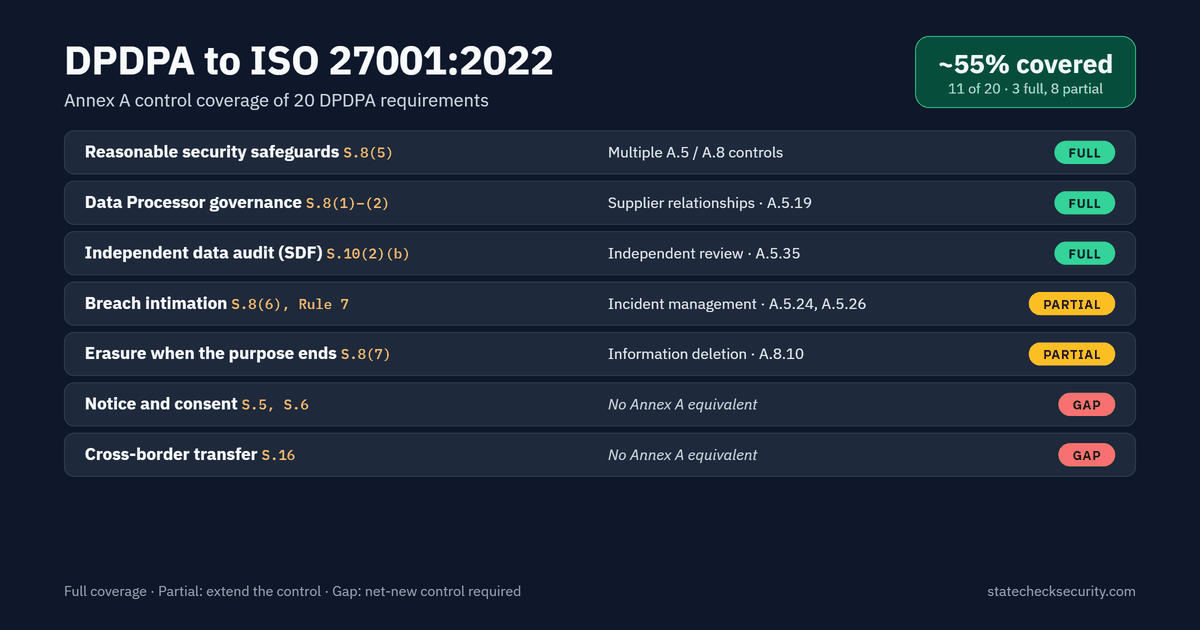
- ISO 27001:2022 covers approximately 55% of DPDPA's technical obligations — 11 of 20 granular requirements, with 3 at full coverage and 8 at partial coverage.
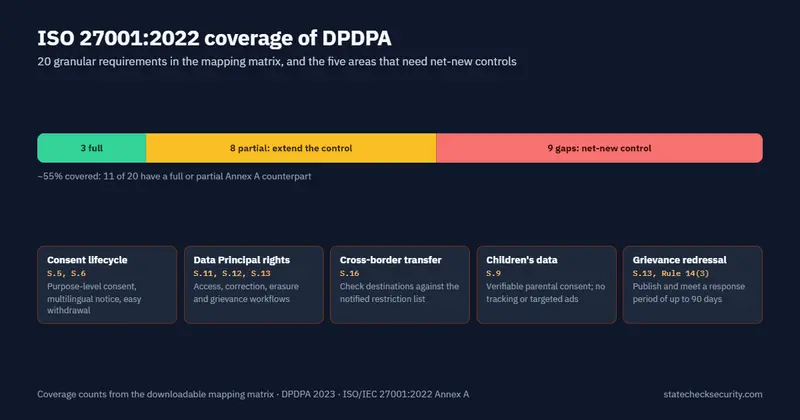
- Five obligation areas have no ISO 27001 equivalent: consent lifecycle management, Data Principal rights fulfilment, cross-border transfer controls, children's data protections, and grievance redressal.
- ISO 27001 certification does NOT equal DPDPA compliance — the Act adds privacy-specific obligations that an ISMS was never designed to address.
- The largest single gap is consent management (Sections 5 and 6): purpose-scoped consent records, withdrawal workflows, and Consent Manager integration are entirely absent from Annex A.
- Board notification under Section 8(6) is a net-new regulatory reporting obligation; A.5.24 and A.5.26 cover internal incident planning and response only.
- A.8.10 (Information Deletion) requires the deepest extension — DPDPA adds consent withdrawal and purpose completion as statutory erasure triggers beyond anything in ISO 27001's scope.
- If you may be classified as a Significant Data Fiduciary, pre-build your DPO role, DPIA methodology, and independent audit contracts now — Section 10's obligations are substantially more demanding.
Key terms: Data Fiduciary — entity determining purpose and means of processing personal data (GDPR equivalent: Data Controller). ISMS — Information Security Management System; the ISO 27001-certified framework of policies, procedures, and controls. Annex A — the reference control set in ISO 27001:2022 containing 93 controls across 4 themes (Organisational, People, Physical, Technological). Technical and Organisational Measures (TOMs) — the "appropriate technical and organisational measures" every Data Fiduciary must implement under Section 8(4); Rule 6(1) of the DPDP Rules 2025 lists the minimum reasonable security safeguards (encryption, access control, logging, backups, processor contracts). Data Principal Rights — rights of individuals under DPDPA including correction, erasure, nomination, and grievance redressal (Sections 12–14). Significant Data Fiduciary (SDF) — an entity notified by the Central Government under Section 10 as processing data at high volume or sensitivity, subject to additional obligations including DPO appointment, DPIA, and independent audit.
Table of Contents
- Introduction
- The Legal Foundation: Key DPDPA Obligations
- How Much of DPDPA Does ISO 27001:2022 Actually Cover?
- Downloadable Resources
- The Engineering Translation: Control-by-Control Analysis
- DPDPA-to-ISO 27001 Control Flow
- Implementation Guide: Extending Your ISMS for DPDPA
- DPDPA vs GDPR: How the Compliance Frameworks Differ
- FAQ: DPDPA and ISO 27001
- Key Takeaways
- Next Steps
Introduction
India's Digital Personal Data Protection Act, 2023 (DPDPA) imposes concrete obligations on every entity that processes digital personal data of individuals within India. For engineering and security teams at organisations that already maintain an ISO 27001:2022 Information Security Management System (ISMS), the obvious question is: how much of this do we already cover?
The answer is nuanced. A mature DPDPA ISO 27001 mapping reveals that approximately 55% of DPDPA's technical obligations (11 of 20 at granular level) have a direct or partial counterpart in Annex A. The remaining 45% -- particularly around consent management, data principal rights, and breach notification to a regulator -- require net-new controls that ISO 27001 was never designed to address.
This article provides a systematic, control-by-control crosswalk between DPDPA's statutory obligations and ISO 27001:2022 Annex A. It is written for security architects, CISOs, and compliance engineers who need to translate legal text into infrastructure decisions.
The Legal Foundation: Key DPDPA Obligations
Before mapping controls, we need to establish what the DPDPA actually requires. The following obligations are drawn directly from the Act's text and are the ones most relevant to an ISO 27001 mapping exercise.
Consent and Notice (Sections 5 and 6)
The DPDPA requires Data Fiduciaries to obtain free, specific, informed, and unambiguous consent before processing personal data. Section 5 mandates that every consent request be accompanied by a notice describing the data collected and its purpose.
"Every request made to a Data Principal under section 6 for consent shall be accompanied or preceded by a notice given by the Data Fiduciary to the Data Principal, informing her,— (i) the personal data and the purpose for which the same is proposed to be processed; (ii) the manner in which she may exercise her rights under sub-section (4) of section 6 and section 13..." -- Section 5(1), DPDPA 2023
Section 6(1) further specifies that consent must be "limited to such personal data as is necessary for such specified purpose" -- establishing a statutory basis for data minimisation.
Reasonable Security Safeguards (Section 8(5))
This is the obligation that maps most directly to ISO 27001's core premise.
"A Data Fiduciary shall protect personal data in its possession or under its control, including in respect of any processing undertaken by it or on its behalf by a Data Processor, by taking reasonable security safeguards to prevent personal data breach." -- Section 8(5), DPDPA 2023
The Act does not prescribe specific technical standards. The phrase "reasonable security safeguards" gives organisations discretion -- and an ISO 27001 certification is strong evidence of meeting this standard. Rule 6(1) of the DPDP Rules 2025 (in force 13 May 2027) then sets a minimum floor: encryption, obfuscation, masking or virtual tokens; access control; logs, monitoring and review; backups for continued processing; one-year retention of logs and personal data (Rule 6(1)(e)); security clauses in Data Processor contracts; and technical and organisational measures. Check each item against your Statement of Applicability.
Data Accuracy and Completeness (Section 8(3))
When personal data is used for decisions affecting a Data Principal or disclosed to another Data Fiduciary, Section 8(3) requires the processing entity to "ensure its completeness, accuracy and consistency."
Breach Notification (Section 8(6))
"In the event of a personal data breach, the Data Fiduciary shall give the Board and each affected Data Principal, intimation of such breach in such form and manner as may be prescribed." -- Section 8(6), DPDPA 2023
This creates a dual notification obligation: to the Data Protection Board of India and to affected individuals. Rule 7 of the DPDP Rules 2025 runs two clocks. Each affected Data Principal (Rule 7(1)) and the Board (Rule 7(2)(a)) get an initial intimation "without delay". A detailed report then goes to the Board within 72 hours of becoming aware of the breach (Rule 7(2)(b)), or within a longer period the Board allows on a written request.
Data Erasure on Purpose Completion (Section 8(7))
"A Data Fiduciary shall, unless retention is necessary for compliance with any law for the time being in force,— (a) erase personal data, upon the Data Principal withdrawing her consent or as soon as it is reasonable to assume that the specified purpose is no longer being served, whichever is earlier; and (b) cause its Data Processor to erase any personal data that was made available by the Data Fiduciary for processing to such Data Processor." -- Section 8(7), DPDPA 2023
This is a storage limitation obligation that triggers erasure proactively, not only upon request. Two Rules shape it. Rule 8(3) sets a floor: every Data Fiduciary keeps personal data, associated traffic data and processing logs for at least one year from the date of processing, then erases them unless another law requires longer. Rule 8(1) and the Third Schedule set a ceiling for large e-commerce, online-gaming and social-media platforms: erase after three years of inactivity, with a 48-hour warning first (Rule 8(2)).
Right to Correction and Erasure (Section 12)
Data Principals have the right to request correction, completion, updating, and erasure of their personal data. The Data Fiduciary must comply unless retention is required by law.
Data Processor Governance (Section 8(1)-(2))
The Data Fiduciary remains responsible for compliance "in respect of any processing undertaken by it or on its behalf by a Data Processor" and may only engage Data Processors "under a valid contract."
Additional Obligations for Significant Data Fiduciaries (Section 10)
Entities notified as Significant Data Fiduciaries must appoint a Data Protection Officer based in India, conduct periodic Data Protection Impact Assessments, and engage independent data auditors. Rule 13(1)–(2) of the DPDP Rules 2025 makes the DPIA and audit an annual cycle (once every twelve months) and requires a report of significant observations to the Board.
How Much of DPDPA Does ISO 27001:2022 Actually Cover?
The following matrix maps each DPDPA obligation to the most relevant ISO 27001:2022 Annex A control(s). The "Coverage" column indicates whether ISO 27001 fully satisfies the DPDPA requirement, partially addresses it, or leaves a gap requiring a custom control.
| DPDPA Obligation | Section | ISO 27001:2022 Control | Control ID | Coverage |
|---|---|---|---|---|
| Consent management | S.5, S.6 | -- | -- | Gap |
| Notice to Data Principals | S.5 | -- | -- | Gap |
| Purpose limitation / data minimisation | S.6(1) | Data classification | A.5.12 | Partial |
| Reasonable security safeguards | S.8(5) | Multiple (see below) | A.8.* | Full |
| Data accuracy and completeness | S.8(3) | Information transfer | A.5.14 | Partial |
| Breach notification (Board + individual) | S.8(6) | Incident management planning and response | A.5.24, A.5.26 | Partial |
| Data erasure on purpose completion | S.8(7) | Information deletion | A.8.10 | Partial |
| Right to correction and erasure | S.12 | Information deletion | A.8.10 | Partial |
| Data Processor contractual governance | S.8(1)-(2) | Information security in supplier relationships | A.5.19 | Full |
| Cross-border transfer restrictions | S.16 | -- | -- | Gap |
| DPO appointment (SDF) | S.10(2)(a) | Information security roles and responsibilities | A.5.2 | Partial |
| Data Protection Impact Assessment (SDF) | S.10(2)(c) | Information security risk assessment; privacy and protection of PII | Clause 6.1.2, A.5.34 | Partial |
| Independent data audit (SDF) | S.10(2)(b) | Independent review of information security | A.5.35 | Full |
| Children's data processing | S.9 | -- | -- | Gap |
| Grievance redressal mechanism | S.13 | -- | -- | Gap |
The Engineering Translation: Control-by-Control Analysis
Where ISO 27001 Provides Full Coverage
A.5.19 -- Information Security in Supplier Relationships maps directly to Section 8(1)-(2)'s requirement for contractual governance of Data Processors. If your ISMS already enforces security requirements in supplier contracts, you satisfy this DPDPA obligation. Ensure your Data Processing Agreements (DPAs) explicitly reference DPDPA obligations, including the Data Processor's duty to erase data when instructed.
A.5.35 -- Independent Review of Information Security addresses Section 10(2)(b)'s requirement for Significant Data Fiduciaries to engage independent data auditors. Your existing internal audit programme and external certification audits provide a foundation, though the DPDPA audit must specifically assess personal data processing compliance, not just information security posture.
Where ISO 27001 Provides Partial Coverage
A.5.12 -- Data Classification partially addresses Section 6(1)'s data minimisation requirement. ISO 27001 requires you to classify information based on confidentiality, integrity, and availability needs. Extend this scheme to include a "personal data" classification tier that maps to DPDPA's definition of digital personal data, and enforce purpose-bound access controls on that tier.
# Example: Extended data classification policy (policy-as-code)
data_classification:
  tiers:
    - level: public
      controls: [integrity_check]
    - level: internal
      controls: [access_control, integrity_check]
    - level: confidential
      controls: [access_control, encryption_at_rest, integrity_check]
    - level: personal_data_dpdpa
      controls: [access_control, encryption_at_rest, encryption_in_transit,
                 purpose_binding, retention_enforcement, erasure_capability,
                 consent_verification, audit_logging]
      retention_policy: purpose_bound
      erasure_trigger: [consent_withdrawal, purpose_completion]
A.8.10 -- Information Deletion is the closest Annex A control to Sections 8(7) and 12, but it requires extension. ISO 27001's A.8.10 focuses on secure deletion of information when no longer needed. DPDPA adds two specific triggers: (1) consent withdrawal, and (2) the specified purpose no longer being served. Your deletion workflows must handle both triggers programmatically.
# Pseudocode: DPDPA-compliant deletion workflow
class DPDPADeletionService:
    """Handles erasure obligations under DPDPA Sections 8(7) and 12."""

    def evaluate_erasure_trigger(self, data_principal_id: str) -> ErasureAction:
        record = self.data_registry.get(data_principal_id)

        # Trigger 1: Consent withdrawn (Section 8(7)(a))
        if record.consent_status == ConsentStatus.WITHDRAWN:
            return ErasureAction(
                type="full_erasure",
                reason="consent_withdrawal",
                legal_hold_check=True  # S.8(7) exception for legal retention
            )

        # Trigger 2: Purpose no longer served (Section 8(7)(a), 8(8))
        if self._purpose_expired(record):
            return ErasureAction(
                type="full_erasure",
                reason="purpose_completion",
                legal_hold_check=True
            )

        # Trigger 3: Data Principal request (Section 12(3))
        if record.pending_erasure_request:
            return ErasureAction(
                type="requested_erasure",
                reason="data_principal_request",
                legal_hold_check=True
            )

        return ErasureAction(type="no_action")

    def _purpose_expired(self, record) -> bool:
        """Section 8(8): purpose deemed no longer served if
        Data Principal has not approached for performance AND
        has not exercised rights for the prescribed period.
        Rule 8(1) + Third Schedule prescribe 3 years only for large
        e-commerce, online-gaming and social-media platforms (with a
        48-hour warning under Rule 8(2)). Any erasure must still
        respect the Rule 8(3) one-year minimum retention."""
        prescribed_period = self.config.get_retention_period(
            fiduciary_class=record.fiduciary_class,
            purpose=record.processing_purpose
        )
        last_interaction = max(
            record.last_approach_date,
            record.last_rights_exercise_date
        )
        return (datetime.now() - last_interaction) > prescribed_period
A.5.24 and A.5.26 -- Incident management planning and response provide a foundation for breach notification under Section 8(6), but the DPDPA adds a regulatory reporting dimension. ISO 27001 focuses on internal incident management processes. DPDPA requires notification to the Data Protection Board of India and to each affected Data Principal. Your incident response playbook needs a DPDPA-specific escalation path.
Clause 6.1.2 (information security risk assessment) and A.5.34 (privacy and protection of PII) partially address the Data Protection Impact Assessment requirement for Significant Data Fiduciaries under Section 10(2)(c)(i). A DPIA under DPDPA is broader than an information security risk assessment -- it must include "a description of the rights of Data Principals and the purpose of processing of their personal data, assessment and management of the risk to the rights of the Data Principals."
Where ISO 27001 Leaves Gaps
Five DPDPA obligation areas have no meaningful ISO 27001 counterpart. These require net-new controls. (Note: The downloadable matrix breaks these five conceptual gaps into 9 granular implementation requirements for engineering purposes.)
Gap 1: Consent Lifecycle Management (Sections 5, 6)
ISO 27001 has no concept of individual consent management. You need a dedicated consent management platform that:
- Records consent at the granularity of purpose (not a blanket "I agree")
- Serves multilingual notices in English and any Eighth Schedule language (Section 5(3))
- Supports withdrawal "with the ease of doing so being comparable to the ease with which such consent was given" (Section 6(4))
- Maintains an immutable audit trail proving notice was given and consent obtained (Section 6(10))
- Integrates with Consent Managers registered with the Board (Section 6(7)-(9))
Gap 2: Data Principal Rights Fulfilment (Sections 11, 12, 13)
ISO 27001 does not address Data Subject Access Requests (DSARs). Build an API layer that:
- Accepts and authenticates correction, completion, updating, and erasure requests
- Routes requests to all systems holding that principal's data
- Responds within your published timelines (the Act and Rules set no deadline for access or correction; unresolved requests become grievances, which Rule 14(3) caps at 90 days)
- Maintains an audit log of request receipt, processing, and completion
Gap 3: Cross-Border Transfer Controls (Section 16)
Section 16 enables the Central Government to restrict transfers to specific countries by notification. ISO 27001's information transfer controls (A.5.14) address secure transfer mechanisms, not jurisdictional restrictions. Implement infrastructure-level controls:
# Example: Cloud infrastructure policy for cross-border restrictions
data_residency_policy:
  default_region: ap-south-1  # Mumbai
  restricted_destinations: []  # Updated per MeitY notifications
  enforcement:
    - type: cloud_provider_policy
      mechanism: AWS SCPs / Azure Policy / GCP Org Policies
      action: deny_resource_creation_in_restricted_regions
    - type: network_layer
      mechanism: VPC endpoint policies, PrivateLink
      action: block_egress_to_restricted_jurisdictions
    - type: application_layer
      mechanism: Data residency middleware
      action: validate_destination_before_transfer
Gap 4: Children's Data Protections (Section 9)
DPDPA imposes strict requirements for processing children's data (under 18 years), including verifiable parental consent and a prohibition on tracking, behavioural monitoring, and targeted advertising. ISO 27001 has no age-specific controls. This requires age verification mechanisms and parental consent workflows at the application layer.
Gap 5: Grievance Redressal Mechanism (Section 13)
Data Fiduciaries must provide readily available means of grievance redressal (Section 13(1)) and respond within the prescribed period (Section 13(2)). Rule 14(3) of the DPDP Rules 2025 requires you to publish a reasonable response period not exceeding 90 days on your website or app, and to meet it. This is a product and operations requirement that sits outside traditional ISMS scope.
DPDPA-to-ISO 27001 Control Flow
The following diagram illustrates how a DPDPA compliance obligation flows through an ISO 27001-aligned control architecture, highlighting where existing ISMS controls apply and where DPDPA-specific extensions are required.
flowchart TD
    A[DPDPA Obligation Identified] --> B{Existing ISO 27001<br/>Annex A Control?}
    B -->|Full Coverage| C[Map to Existing Control<br/>e.g., A.5.19, A.5.35]
    B -->|Partial Coverage| D[Extend Existing Control<br/>e.g., A.8.10 + erasure triggers<br/>A.5.24/A.5.26 + regulatory notification]
    B -->|No Coverage| E[Create DPDPA-Specific Control<br/>e.g., Consent Management<br/>DSAR Fulfilment<br/>Cross-Border Restrictions]

    C --> F[Document in SoA<br/>Statement of Applicability]
    D --> F
    E --> F

    F --> G[Implement Technical Controls]
    G --> H[Evidence Collection<br/>for Audit]
    H --> I{Audit Type}
    I -->|ISO 27001 Surveillance| J[Demonstrate via<br/>existing audit cycle]
    I -->|DPDPA Board Inquiry| K[Produce DPDPA-specific<br/>evidence package]
    I -->|SDF Mandatory Audit| L[Independent data auditor<br/>assesses combined controls]

    style E fill:#f9d6d6,stroke:#d44,stroke-width:2px
    style D fill:#fef3cd,stroke:#d4a,stroke-width:2px
    style C fill:#d4edda,stroke:#28a745,stroke-width:2px
Alt Text: Flowchart showing the decision process for mapping DPDPA obligations to ISO 27001 Annex A controls, with three paths -- full coverage (green), partial coverage (yellow), and gap requiring new DPDPA-specific controls (red) -- all converging into the Statement of Applicability and audit evidence collection.
Implementation Guide: Extending Your ISMS for DPDPA
Step 1: Audit Your Statement of Applicability (SoA)
Your ISO 27001 SoA declares which Annex A controls are applicable and why. Add a "DPDPA Relevance" column to every control. For the 15 obligations mapped above, annotate whether each control provides full, partial, or no coverage.
Step 2: Build the Consent Management Layer
This is the highest-effort gap. Options range from build-to-buy:
- Build: A purpose-scoped consent API backed by an immutable event store (e.g., Apache Kafka with log compaction disabled for consent topics). Implement the multilingual notice requirement using i18n frameworks with Eighth Schedule language packs.
- Buy: Evaluate consent management platforms that support DPDPA-specific requirements, particularly Consent Manager interoperability (Section 6(7)-(9)).
- Hybrid: Use a CMP for the frontend consent UX, but maintain your own consent event store for audit trail integrity.
Step 3: Extend Incident Response for Regulatory Notification
Add a DPDPA branch to your incident response playbook:
- Detection -- Existing SIEM/EDR tooling (covered by A.5.24 and A.5.26)
- Classification -- Does the incident involve "digital personal data" per Section 2(n)? Does it constitute a "personal data breach" per Section 2(u)?
- Regulatory triage -- If yes to both, initiate parallel notification to the Data Protection Board and affected Data Principals in the prescribed form
- Evidence preservation -- Capture the incident timeline, scope of data affected, and remediation steps for potential Board inquiry
Step 4: Implement Purpose-Bound Retention and Erasure
Tag every personal data record with:
- The specified purpose for which consent was obtained
- The consent timestamp and consent version
- The last interaction date (for Section 8(8) purpose expiry calculation)
Build automated retention jobs that evaluate erasure triggers nightly. Integrate with backup systems to ensure erasure cascades to cold storage within a defined SLA.
Step 5: Prepare for SDF Obligations (If Applicable)
If your organisation may be notified as a Significant Data Fiduciary under Section 10, pre-build:
- A DPO role with reporting lines to the Board of Directors
- A DPIA methodology that extends your existing risk assessment process to cover Data Principal rights
- Contracts with independent data auditors who understand both ISO 27001 and DPDPA
DPDPA vs GDPR: How the Compliance Frameworks Differ
For organisations operating across India and the EU, understanding how DPDPA compares to GDPR is essential for scoping an ISO 27001 extension project. The two regimes share a conceptual lineage but diverge in material ways that affect control design.
| Dimension | DPDPA 2023 (India) | GDPR (EU) |
|---|---|---|
| Scope | Digital personal data of individuals in India only; no analogue data | All personal data (digital and analogue) of EU data subjects |
| Lawful bases | Consent + legitimate uses (Section 7); no "legitimate interests" basis | Six lawful bases including legitimate interests (Article 6) |
| Sensitive data category | None — DPDPA has NO statutory "sensitive personal data" category | Special categories (Article 9): health, biometric, racial origin, etc. |
| Children's age threshold | Under 18 (Section 9) | Under 16 (Article 8; Member States may lower to 13) |
| Cross-border transfers | Negative-list model: default permissive; Central Government restricts specific countries (Section 16) | Adequacy decisions, SCCs, BCRs required; default restrictive |
| Data breach notification | Board + each affected Data Principal (Section 8(6)); Rule 7: initial intimation to both "without delay", then a detailed Board report within 72 hours of awareness, extendable by the Board on written request | Supervisory authority within 72 hours; individuals for high-risk breaches |
| Right to erasure trigger | Consent withdrawal OR purpose completion — whichever is earlier (Section 8(7)) | Multiple grounds including withdrawal, no legitimate grounds (Article 17) |
| Data Protection Officer | Required only for Significant Data Fiduciaries (Section 10) | Required for public bodies and high-risk processing at scale (Article 37) |
| Regulator | Data Protection Board of India (quasi-judicial) | National data protection authorities (DPAs) per Member State |
| Penalties | Up to ₹250 crore, with the cap varying by breach type (Section 33(1) and the Schedule) | Up to €20 million or 4% of global annual turnover (Article 83) |
| ISO 27001 coverage | ~55% of technical obligations covered (11 of 20 requirements) | ~55% of technical obligations covered (GDPR adds extensive processor accountability rules) |
Key design implication: Because DPDPA has no sensitive data category, you cannot implement a two-tier data classification for "personal" vs "special category" personal data the way GDPR-aligned systems do. All personal data is governed uniformly under Section 8(5). Your ISO 27001 extension should reflect this flat model rather than importing GDPR's tiered structure.
FAQ: DPDPA and ISO 27001
Does ISO 27001 certification satisfy DPDPA compliance requirements?
No. ISO 27001 provides a strong security foundation, but DPDPA has privacy-specific obligations -- consent management, Data Principal rights, breach notification to a regulator, and purpose-bound data retention -- that ISO 27001 was not designed to cover. Think of ISO 27001 as covering the "reasonable security safeguards" requirement of Section 8(5), with significant gaps elsewhere. Certification is evidence of meeting one clause of DPDPA, not the whole Act.
Which DPDPA obligations have no ISO 27001 equivalent?
Five obligation areas fall entirely outside Annex A's scope: (1) consent lifecycle management (Sections 5–6), (2) Data Principal rights fulfilment including correction, erasure, and grievance redressal (Sections 12–13), (3) cross-border transfer restrictions based on country-specific government notifications (Section 16), (4) children's data processing including verifiable parental consent and tracking prohibitions (Section 9), and (5) the grievance redressal mechanism with prescribed response timelines (Section 13).
What is the gap between ISO 27001 and DPDPA for consent management?
ISO 27001 has no concept of individual consent management. Annex A controls address information classification, access control, and supplier contracts -- none of which capture the purpose-scoped consent lifecycle that DPDPA requires. You need a dedicated consent management layer that records consent at the granularity of purpose, supports withdrawal with equivalent ease, maintains an immutable audit trail per Section 6(10), and can integrate with Consent Managers registered with the Board under Section 6(7)–(9). This is a net-new engineering workstream with no Annex A shortcut.
How does DPDPA Section 8(5) relate to ISO 27001's core premise?
Section 8(5) requires Data Fiduciaries to protect personal data by taking "reasonable security safeguards to prevent personal data breach." The Act does not prescribe specific technical standards, though Rule 6(1) of the DPDP Rules 2025 lists minimum safeguards (including one-year log retention) to check your controls against. An ISO 27001-certified ISMS -- with controls implemented proportionate to data volume and sensitivity -- is a defensible evidence base for meeting this standard. This is the strongest alignment point between the two frameworks; it covers your baseline security posture but leaves all privacy-specific obligations unaddressed.
How does DPDPA differ from GDPR in its approach to framework compliance?
The most material engineering difference is the cross-border transfer model. GDPR defaults to restriction and requires adequacy decisions or SCCs; DPDPA defaults to permission and restricts specific countries by government notification (a negative-list model). This means any Rego policy or IAM rule that gates data transfers must use default transfer_allowed := true and block only on a notified blocklist -- never a positive allowlist of approved countries. Additionally, DPDPA has no sensitive personal data statutory category (that concept was in the 2019 PDP Bill but removed). All personal data is subject to uniform Section 8(5) obligations, which simplifies your data classification model compared to GDPR's two-tier scheme.
Key Takeaways
- ISO 27001:2022 covers approximately 55% of DPDPA's technical obligations (11 of 20 granular requirements: 3 with full coverage, 8 with partial coverage), primarily through controls for security safeguards, supplier governance, incident management, and audit.
- Five critical gap areas remain (9 granular obligations in the downloadable matrix): consent management, Data Principal rights fulfilment, cross-border transfer controls, children's data protections, and grievance redressal. These require net-new controls.
- A.8.10 (Information Deletion) is the control that requires the most significant extension -- DPDPA adds consent withdrawal and purpose completion as erasure triggers beyond ISO 27001's scope.
- Section 8(5)'s "reasonable security safeguards" is your strongest ISO 27001 alignment point -- your existing certification is direct evidence of meeting this standard.
- Extend your Statement of Applicability with a DPDPA relevance column to create a single audit artifact that demonstrates both ISO 27001 and DPDPA compliance.
- If you may be classified as a Significant Data Fiduciary, pre-build your DPO role, DPIA methodology, and independent audit contracts now -- Section 10's obligations are substantially more demanding.
Next Steps
Need help building your DPDPA-ISO 27001 mapping for audit readiness? StateCheck Security provides hands-on compliance architecture reviews that start with your existing ISMS and identify exactly what needs to change for DPDPA. We do not just hand you a spreadsheet -- we work with your engineering team to implement the controls.
Request a DPDPA Compliance Audit
Related Articles
- SOC 2 Privacy Criteria vs. DPDPA: Bridging the Gap for Indian SaaS Companies -- If you hold both ISO 27001 and SOC 2, this companion piece maps the SOC 2 Trust Services Criteria to DPDPA for a unified compliance view.
- NIST Privacy Framework to DPDPA: A Technical Crosswalk -- Extends this mapping to NIST's Identify, Govern, Control, and Communicate functions.
- Engineering Privacy by Design: Implementing DPDPA at the CI/CD Pipeline -- Takes the controls identified in this mapping guide and shows how to enforce them through automated pipeline checks.