
SOC 2 Privacy Criteria vs. DPDPA: Bridging the Gap for Indian SaaS Companies
Key Takeaways
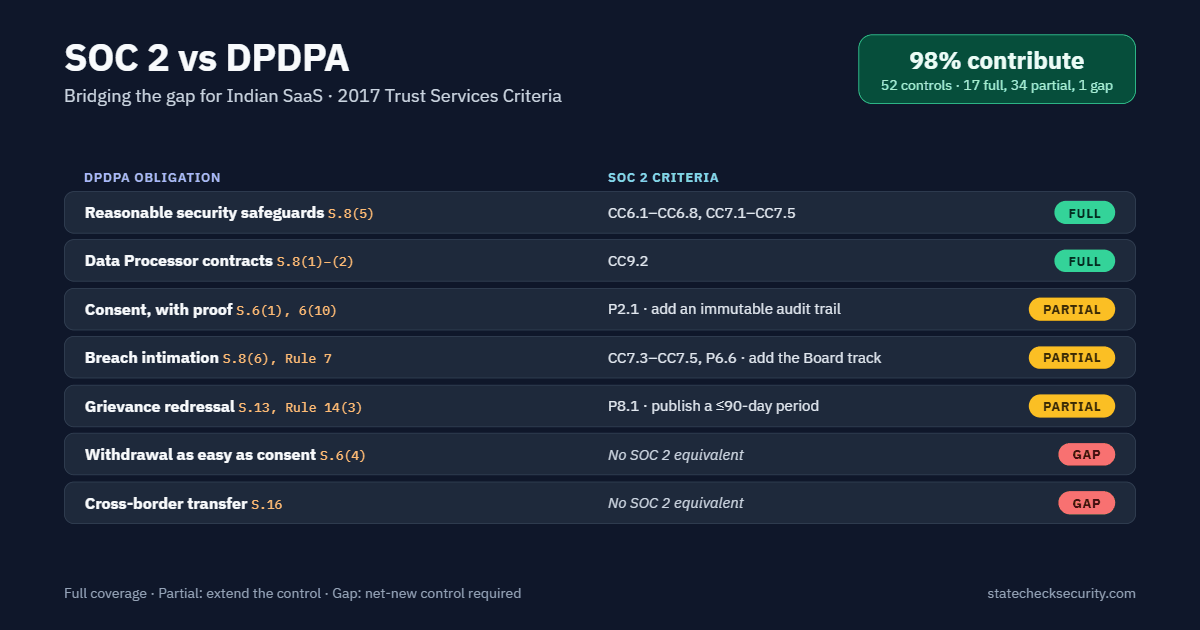
- SOC 2 controls contribute to 98% of DPDPA compliance obligations — 33% provide full alignment, 65% need DPDPA-specific extensions, and only 2% are pure gaps with no SOC 2 equivalent.
- The SOC 2 Security TSC (CC6.x, CC7.x) fully covers DPDPA Section 8(5) "reasonable security safeguards" — document this mapping as your primary evidence for Data Protection Board inquiries.
- The SOC 2 Privacy TSC (P1–P8) partially covers consent, notice, access, and data lifecycle obligations under Sections 5, 6, 11, and 12 — but each needs DPDPA-specific extensions.
- Myth: SOC 2 Type II certification does NOT automatically satisfy DPDPA compliance. The Data Protection Board of India does not recognise SOC 2 as a legal exemption.
- Three obligations have no SOC 2 equivalent: consent withdrawal with equal ease (S.6(4)), Consent Manager interoperability (S.6(7)–(9)), and cross-border transfer restrictions (S.16). Grievance redressal (S.13) is a partial gap: SOC 2 P8.1 covers complaint handling. (The downloadable matrix maps SOC 2 controls to DPDPA, so it shows 1 gap control; obligations with no SOC 2 control at all are not rows there.)
- Breach notification is the highest-risk gap: SOC 2 CC7.x covers detection and response, but DPDPA adds mandatory breach intimation on two clocks: "without delay" to each affected Data Principal and to the Data Protection Board (Rule 7(1), Rule 7(2)(a)), then a detailed Board report within 72 hours (Rule 7(2)(b)) — SOC 2 P6.6 covers notifying data subjects and regulators, but not these clocks or the content Rule 7 prescribes.
- SaaS companies act as Data Processors under DPDPA; DPDP Rules Rule 6(1)(f) requires their Data Fiduciary clients to write security-safeguard obligations into the processing contract, so those standards reach the SaaS vendor by contract.
Key terms: Data Fiduciary — entity determining the purpose and means of processing personal data (GDPR equivalent: Data Controller; SOC 2 equivalent: Service Organisation). SOC 2 — Service Organisation Control 2; an AICPA auditing standard evaluated against five Trust Services Criteria: Security (CC), Availability (A), Confidentiality (C), Processing Integrity (PI), and Privacy (P). Trust Services Criteria (TSC) — the control categories evaluated in a SOC 2 audit. Technical and Organisational Measures (TOMs) — measures a Data Fiduciary must implement under DPDPA Section 8(4); the minimum security safeguards are listed in DPDP Rules 2025, Rule 6(1). Data Principal Rights — individual rights under DPDPA including correction, erasure, nomination, and grievance redressal. Data Protection Board (DPB) — the adjudicatory body established under DPDPA with powers to investigate breaches and impose penalties.
Table of Contents
- Introduction
- The Legal Foundation: DPDPA Obligations That Matter for SaaS
- Can SOC 2 Type II Alone Satisfy DPDPA Compliance?
- The Engineering Translation: Closing the Gaps
- Cross-Framework Reference: ISO 27001 and NIST Anchors
- DPDPA vs. SOC 2 vs. GDPR: Regulatory Comparison
- Common Pitfalls and FAQ
- Key Takeaways
- Next Steps
Introduction
Indian SaaS companies selling into US enterprise accounts have a familiar playbook: achieve SOC 2 Type II, pass the vendor security questionnaire, close the deal. That playbook now has an addendum. With the Digital Personal Data Protection Act (DPDPA) 2023 entering its phased enforcement and the DPDP Rules 2025 setting operational deadlines through May 2027, every SaaS company processing digital personal data of Indian users must satisfy a parallel set of obligations that SOC 2 was never designed to address.
The good news: SOC 2 DPDPA compliance is not a from-scratch effort. The AICPA's Trust Services Criteria -- particularly the Privacy (P-series) and Common Criteria (CC-series) controls -- overlap meaningfully with DPDPA's requirements around security safeguards, access controls, and data lifecycle management. The engineering challenge is identifying exactly where SOC 2 stops and DPDPA begins, then closing those gaps without building a parallel compliance infrastructure.
This article provides that map. It is written for security architects and compliance engineers at Indian SaaS companies who need to present a unified control framework to both their SOC 2 auditor and the Data Protection Board of India.
The Legal Foundation: DPDPA Obligations That Matter for SaaS
Before we map controls, we need to establish the DPDPA obligations most relevant to a SOC 2 comparison. The following are drawn directly from the Act's gazette text.
Consent and Notice (Sections 5 and 6)
"The consent given by the Data Principal shall be free, specific, informed, unconditional and unambiguous with a clear affirmative action, and shall signify an agreement to the processing of her personal data for the specified purpose and be limited to such personal data as is necessary for such specified purpose." -- Section 6(1), DPDPA 2023
Section 5(1) requires that every consent request be accompanied by a notice detailing the personal data collected, its purpose, and how the Data Principal can exercise her rights. Section 5(3) mandates that this notice be available in English or any Eighth Schedule language -- a requirement with direct technical implications for SaaS platforms serving India's linguistically diverse user base.
Section 6(4) grants Data Principals the right to withdraw consent "with the ease of doing so being comparable to the ease with which such consent was given." Section 6(10) places the burden of proof on the Data Fiduciary to demonstrate that valid notice was given and consent obtained.
Reasonable Security Safeguards (Section 8(5))
"A Data Fiduciary shall protect personal data in its possession or under its control, including in respect of any processing undertaken by it or on its behalf by a Data Processor, by taking reasonable security safeguards to prevent personal data breach." -- Section 8(5), DPDPA 2023
This is the obligation with the highest SOC 2 overlap. The DPDPA does not prescribe specific technical standards, making SOC 2 Security TSC controls strong evidence of compliance.
Data Processor Governance (Sections 8(1) and 8(2))
Section 8(1) makes the Data Fiduciary responsible for compliance "in respect of any processing undertaken by it or on its behalf by a Data Processor." Section 8(2) requires a valid contract for any Data Processor engagement. For SaaS companies, this cuts both ways: you are a Data Processor to your enterprise clients (who are Data Fiduciaries), and you may engage sub-processors yourself.
Breach Notification (Section 8(6))
"In the event of a personal data breach, the Data Fiduciary shall give the Board and each affected Data Principal, intimation of such breach in such form and manner as may be prescribed." -- Section 8(6), DPDPA 2023
The DPDP Rules 2025 prescribe that form and manner in Rule 7, which runs on two clocks. On becoming aware of a breach, the Data Fiduciary must intimate each affected Data Principal "without delay" (Rule 7(1)) and give the Board an initial description of the breach "without delay" (Rule 7(2)(a)). It must then send the Board a detailed report "within seventy-two hours of becoming aware of the breach", or within a longer period the Board allows on a written request (Rule 7(2)(b)). Rule 7(2)(b) also lists the report's contents, including the broad facts, mitigation and remedial measures, and a report on the intimations given to Data Principals. This dual notification requirement (Board + affected individuals) goes beyond SOC 2's incident management controls, which focus on internal processes rather than regulatory reporting.
Data Erasure (Section 8(7))
"A Data Fiduciary shall, unless retention is necessary for compliance with any law for the time being in force,— (a) erase personal data, upon the Data Principal withdrawing her consent or as soon as it is reasonable to assume that the specified purpose is no longer being served, whichever is earlier;" -- Section 8(7)(a), DPDPA 2023
Section 8(8) deems the purpose "to no longer be served" if the Data Principal has not approached the Data Fiduciary or exercised any rights for a prescribed period. The DPDP Rules 2025 prescribe that period only for the classes in the Third Schedule (large e-commerce, online gaming and social media platforms: three years of inactivity, with a 48-hour warning before erasure, Rule 8(1)–(2)). This creates a proactive erasure obligation triggered by inactivity -- not just by explicit request.
Data Principal Rights (Sections 11 and 12)
Section 11 grants Data Principals the right to obtain a summary of their personal data and processing activities, including identities of all Data Fiduciaries and Data Processors with whom data has been shared. Section 12 provides rights to correction, completion, updating, and erasure.
Cross-Border Transfer (Section 16)
Section 16(1) empowers the Central Government to restrict transfers to specific countries by notification. Until such restrictions are notified, transfers are permitted, subject to any requirements the Central Government specifies by order about making personal data available to a foreign State (Rule 15, from 13 May 2027) -- but your architecture must be able to enforce restrictions if they arrive.
Can SOC 2 Type II Alone Satisfy DPDPA Compliance?
The following comparison table maps each DPDPA obligation to the most relevant SOC 2 Trust Services Criteria. The "Gap Status" column indicates whether SOC 2 fully covers, partially covers, or leaves a gap requiring additional controls.
| DPDPA Obligation | Section | SOC 2 TSC | Control ID | Gap Status | Action Required |
|---|---|---|---|---|---|
| Notice to Data Principals | S.5(1), S.5(3) | Notice & Communication | P1.1 | Partial | SOC 2 P1.1 requires privacy notice but not multilingual delivery. Add i18n notice framework for Eighth Schedule languages. |
| Consent (free, specific, informed) | S.6(1) | Choice and Consent | P2.1 | Partial | SOC 2 P2.1 covers opt-in/opt-out choices. DPDPA requires purpose-granular, verifiable consent with immutable audit trails (S.6(10)). |
| Consent withdrawal (equal ease) | S.6(4) | Choice and Consent | P2.1 | Gap | SOC 2 has no equivalent to "the ease of doing so being comparable to the ease with which such consent was given" (S.6(4)). Requires UX and API parity. |
| Consent Manager interoperability | S.6(7)-(9) | -- | -- | Gap | No SOC 2 equivalent. Requires API integration with registered Consent Managers per DPDP Rules 2025 (Rule 4 and First Schedule; registration from 13 Nov 2026). |
| Reasonable security safeguards | S.8(5) | Logical & Physical Access, System Ops | CC6.1-CC6.8, CC7.1-CC7.5 | Full | SOC 2 Security TSC provides comprehensive coverage. Document the mapping for Board inquiries. |
| Data Processor contractual governance | S.8(1)-(2) | Vendor & Supply Chain | CC9.2 | Full | SOC 2 CC9.2 requires risk assessment and monitoring of vendors. Extend DPAs to reference DPDPA obligations explicitly. |
| Data accuracy and consistency | S.8(3) | Quality | P7.1 | Partial | SOC 2 P7.1 addresses data quality. DPDPA triggers this specifically when data is used for decisions affecting the Data Principal or disclosed to another Fiduciary. |
| Breach notification (Board + individuals) | S.8(6) | Incident Management; Disclosure & Notification | CC7.3, CC7.4, CC7.5, P6.6 | Partial | SOC 2 covers incident detection and response, and P6.6 covers notifying data subjects and regulators. DPDPA adds mandatory intimation "without delay" to each affected Data Principal (Rule 7(1)) and to the DPB (Rule 7(2)(a)), plus a detailed DPB report within 72 hours (Rule 7(2)(b)). |
| Erasure on purpose completion | S.8(7)-(8) | Use, Retention, Disposal | P4.2, P4.3 | Partial | SOC 2 P4.2/P4.3 covers retention and disposal policies. DPDPA adds two specific triggers: consent withdrawal and purpose expiry (inactivity-based). |
| Right to access and data summary | S.11 | Access | P5.1, P5.2 | Partial | SOC 2 P5.1 covers access requests. DPDPA requires disclosure of all downstream Fiduciaries and Processors (S.11(1)(b)). |
| Right to correction and erasure | S.12 | Access | P5.2 | Partial | SOC 2 P5.2 covers dispute resolution. DPDPA adds a statutory right (S.12), with requests made through the means the Fiduciary publishes (Rule 14(1)–(2)). |
| Grievance redressal mechanism | S.13 | Monitoring & Enforcement | P8.1 | Partial | P8.1 covers receiving and resolving complaints. DPDPA adds a published response period of no more than 90 days (Rule 14(3)) and that the Data Principal must use it before approaching the Board (S.13(3)). |
| Cross-border transfer restrictions | S.16 | -- | -- | Gap | No SOC 2 equivalent. Requires infrastructure-level controls to enforce country-specific restrictions on demand. |
flowchart LR
    A[DPDPA Obligation] --> B{SOC 2 TSC<br/>Mapping Exists?}
    B -->|Full Coverage| C[CC6.x Security<br/>CC9.2 Vendor Mgmt]
    B -->|Partial Coverage| D[P1-P5 Privacy TSC<br/>CC7.x Incident Mgmt]
    B -->|No Coverage| E[Net-New Controls<br/>Required]

    C --> F[Document mapping<br/>for Board evidence]
    D --> G[Extend existing<br/>SOC 2 controls]
    E --> H[Build DPDPA-specific<br/>control layer]

    G --> I[Unified Compliance<br/>Framework]
    F --> I
    H --> I

    style C fill:#d4edda,stroke:#28a745
    style D fill:#fef3cd,stroke:#d4a
    style E fill:#f9d6d6,stroke:#d44
Alt Text: Flowchart showing DPDPA obligations mapped against SOC 2 Trust Services Criteria, with three paths for full coverage (green), partial coverage (yellow), and gap requiring net-new controls (red), all converging into a unified compliance framework.
The Engineering Translation: Closing the Gaps
Gap 1: Verifiable Consent Audit Trails (Section 6 vs. P2.1)
SOC 2 P2.1 requires that you offer Data Principals choices about how their data is collected and used. DPDPA Section 6 goes further: consent must be purpose-granular, and under Section 6(10), the Data Fiduciary bears the burden of proving that notice was given and consent obtained.
Your SOC 2 consent checkbox does not satisfy this. You need an immutable consent ledger.
-- DPDPA-compliant consent audit table
-- Extends SOC 2 P2.1 with verifiable, immutable consent records
CREATE TABLE consent_audit_log (
    audit_id        UUID PRIMARY KEY DEFAULT gen_random_uuid(),
    data_principal_id UUID NOT NULL,
    purpose_key     VARCHAR(100) NOT NULL,  -- e.g., 'analytics', 'marketing'
    action          VARCHAR(20) NOT NULL     -- 'GRANTED', 'REVOKED', 'MODIFIED'
        CHECK (action IN ('GRANTED', 'REVOKED', 'MODIFIED')),
    notice_version  VARCHAR(20) NOT NULL,    -- ties to specific privacy notice
    notice_language VARCHAR(10) NOT NULL,    -- ISO 639-1 code (e.g., 'hi', 'ta')
    ip_address      INET,
    user_agent      TEXT,
    consent_source  VARCHAR(50) NOT NULL     -- 'web_form', 'api', 'consent_manager'
        CHECK (consent_source IN ('web_form', 'api', 'consent_manager', 'in_app')),
    created_at      TIMESTAMPTZ NOT NULL DEFAULT NOW()
);

-- Immutability: no UPDATE or DELETE allowed on this table
-- Enforce via database role permissions or append-only event store
REVOKE UPDATE, DELETE ON consent_audit_log FROM app_service_role;

-- Index for Data Principal access requests (Section 11)
CREATE INDEX idx_consent_principal ON consent_audit_log (data_principal_id, created_at DESC);
For a complete implementation — including the cryptographic receipt binding, 23-language notice cache, and Section 6(10) evidentiary pack — see DPDPA Consent Management API: Building the Evidentiary Architecture.
Gap 2: Breach Notification Pipeline (Section 8(6) vs. CC7.3-CC7.5)
SOC 2's CC7.3 through CC7.5 cover incident detection, analysis, and response. DPDPA adds a regulatory dimension with two clocks. On becoming aware of a breach you must intimate each affected Data Principal "without delay" (Rule 7(1)) and give the Data Protection Board of India an initial intimation "without delay" (Rule 7(2)(a)). You then owe the Board a detailed report within 72 hours of becoming aware, unless the Board allows longer on a written request (Rule 7(2)(b)). The 72-hour clock covers the detailed report only; the initial intimations cannot wait for it.
Extend your existing incident response playbook with a DPDPA-specific branch:
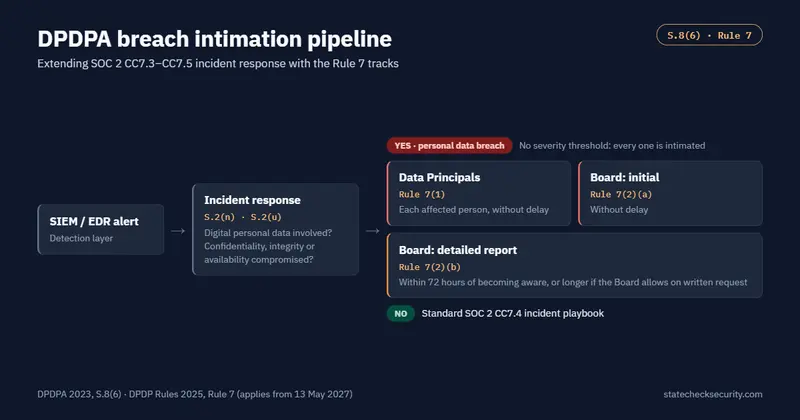
For the full SOAR playbook — including SIEM correlation rules, the DPDPA breach classification engine, Python notification services, and Board report generator — see Automating DPDPA Breach Notification: From SIEM Alert to Legal Workflow.
Gap 3: Purpose-Bound Erasure Automation (Section 8(7) vs. P4.2/P4.3)
SOC 2 P4.2/P4.3 requires that data retention and disposal follow your stated policies. DPDPA adds two erasure triggers that go beyond policy-driven disposal:
- Consent withdrawal (Sections 6(4), 6(6) and 8(7)(a)) -- the Data Principal revokes consent; you must cease processing "within a reasonable time" (S.6(6)) and erase the data unless a law requires you to retain it (S.8(7)(a))
- Purpose expiry (Section 8(8)) -- the Data Principal has not interacted with you or exercised any rights for the prescribed period
# Purpose-bound erasure service
# Closes the gap between SOC 2 P4.2/P4.3 and DPDPA Section 8(7)
from dataclasses import dataclass
from datetime import datetime, timedelta
from enum import Enum
from typing import Optional

class ErasureTrigger(Enum):
    CONSENT_WITHDRAWAL = "consent_withdrawal"    # Section 6(4)
    PURPOSE_COMPLETION = "purpose_completion"     # Section 8(7)(a)
    INACTIVITY_EXPIRY = "inactivity_expiry"       # Section 8(8)
    PRINCIPAL_REQUEST = "principal_request"        # Section 12(3)

@dataclass
class ErasureEvaluation:
    trigger: Optional[ErasureTrigger]
    requires_legal_hold_check: bool
    cascade_to_processors: bool  # Section 8(7)(b)

class DPDPAErasureService:
    """Evaluates and executes erasure obligations under DPDPA.

    Extends SOC 2 P4.2/P4.3 disposal controls with DPDPA-specific
    triggers: consent withdrawal, purpose expiry, and inactivity.
    """

    def __init__(self, retention_config: dict, processor_registry: list):
        self.retention_config = retention_config
        self.processor_registry = processor_registry

    def evaluate(self, principal_id: str) -> ErasureEvaluation:
        record = self.get_data_record(principal_id)

        # Trigger 1: Consent withdrawn (Section 6(4) + 8(7)(a))
        if record.consent_status == "REVOKED":
            return ErasureEvaluation(
                trigger=ErasureTrigger.CONSENT_WITHDRAWAL,
                requires_legal_hold_check=True,
                cascade_to_processors=True
            )

        # Trigger 2: Inactivity-based expiry (Section 8(8))
        prescribed_period = self.retention_config.get(
            record.purpose_key, timedelta(days=1095)  # 3 years: Third Schedule period (Rule 8(1)) for listed large platforms; send the 48-hour warning first (Rule 8(2))
        )
        last_activity = max(
            record.last_approach_date or datetime.min,
            record.last_rights_exercise_date or datetime.min
        )
        if (datetime.now() - last_activity) > prescribed_period:
            return ErasureEvaluation(
                trigger=ErasureTrigger.INACTIVITY_EXPIRY,
                requires_legal_hold_check=True,
                cascade_to_processors=True  # Section 8(7)(b)
            )

        return ErasureEvaluation(
            trigger=None,
            requires_legal_hold_check=False,
            cascade_to_processors=False
        )
Gap 4: Cross-Border Transfer Enforcement (Section 16)
SOC 2 has no concept of jurisdictional transfer restrictions. Section 16(1) allows the Central Government to restrict transfers to specific countries by notification. Your infrastructure must be configurable to enforce these restrictions without code changes.
# Cloud infrastructure policy for DPDPA cross-border restrictions
# No SOC 2 equivalent exists -- this is a net-new control
data_residency_policy:
  default_region: ap-south-1  # AWS Mumbai
  restricted_destinations: []  # Updated per MeitY gazette notifications
  enforcement_layers:
    - type: cloud_provider_scp
      mechanism: AWS Service Control Policies / Azure Policy
      action: deny_resource_creation_outside_allowed_regions
    - type: network_egress
      mechanism: VPC endpoint policies
      action: block_data_egress_to_restricted_jurisdictions
    - type: application_middleware
      mechanism: Transfer validation interceptor
      action: check_destination_country_before_api_response
  monitoring:
    alert_on: attempted_transfer_to_restricted_destination
    log_to: compliance_audit_trail
Gap 5: Grievance Redressal (Section 13)
Section 13(1) requires "readily available means of grievance redressal" for any act or omission regarding the Data Fiduciary's obligations or the Data Principal's rights. SOC 2 has no equivalent. Rule 14(3) of the DPDP Rules 2025 requires you to publish a reasonable grievance response period not exceeding 90 days on your website or app, and to meet it. For SaaS companies, this means building a dedicated grievance intake and tracking system -- not just a generic support ticket queue -- with SLA enforcement tied to the prescribed periods.
Cross-Framework Reference: ISO 27001 and NIST Anchors
For SaaS companies holding multiple certifications, the following cross-references connect your DPDPA gaps to controls in ISO 27001:2022 and NIST CSF 2.0 / Privacy Framework:
| DPDPA Gap | SOC 2 Gap | ISO 27001:2022 | NIST CSF 2.0 / Privacy |
|---|---|---|---|
| Consent lifecycle | No P2.x for verifiable audit | A.5.12 (classification extended) | CT.PO-P1, CT.DM-P1 |
| Multilingual notices | P1.1 lacks language mandate | -- (gap in ISO too) | CM.AW-P1 |
| Breach to regulator | CC7.x lacks regulatory path | A.5.24 (extend to DPB) | RS.CO-02 |
| Purpose-bound erasure | P4.2 lacks DPDPA triggers | A.8.10 (extend triggers) | PR.DS-01, CT.DP-P1 |
| Cross-border restrictions | No equivalent | A.5.14 (extend to jurisdiction) | GV.PO-P1 |
| Grievance redressal | No equivalent | -- (gap in ISO too) | CM.AW-P2 |
| Data Principal rights API | P5.1 lacks S.11(1)(b) scope | -- (gap in ISO too) | CT.DM-P3 |
Note: the encryption controls in the "Full coverage" row (CC6.1-CC6.8 vs. S.8(5) / Rule 6(1)(a)) are where most teams already have the strongest SOC 2-to-DPDPA alignment. For the engineering specification — TLS 1.3, AES-256-GCM, cloud KMS configuration, key rotation policy, and OPA policies enforcing encryption at deploy time — see Implementing Cryptographic Controls for DPDPA: Encryption Standards at Rest and in Transit.
DPDPA vs. SOC 2 vs. GDPR: Regulatory Comparison
For organisations that hold SOC 2 certification and operate across multiple jurisdictions, understanding where DPDPA diverges from both GDPR and SOC 2 is essential for scoping remediation work. The table below covers the six dimensions most likely to produce compliance gaps for Indian SaaS teams.
| Dimension | DPDPA 2023 | SOC 2 (AICPA) | GDPR (EU) |
|---|---|---|---|
| Legal Basis | Consent is the primary basis for processing; S.7 "certain legitimate uses" is a closed list (e.g. voluntarily provided data, State functions, legal obligations, medical emergencies, employment). No broad "legitimate interests" basis for commercial entities. | Not a legal framework; no concept of processing lawfulness. Audits against stated policies. | Six lawful bases including consent, contract, legitimate interests, legal obligation, vital interests, and public task. |
| Transfer Model | Negative-list: transfers permitted by default; Central Government restricts specific countries by notification (S.16). No adequacy decisions. | No concept of jurisdictional transfer restrictions. | Positive-list: transfers permitted only to adequate countries or with appropriate safeguards (SCCs, BCRs, adequacy decisions). |
| Consent Requirement | Free, specific, informed, unconditional, unambiguous, affirmative. Purpose-granular. Burden of proof on Data Fiduciary (S.6(10)). | P2.1 requires notice and choice; no statutory form prescribed. | Freely given, specific, informed, unambiguous. Granular for sensitive data. Right to withdraw "at any time." |
| Breach Notification | Two clocks: initial intimation "without delay" to each affected Data Principal (Rule 7(1)) and to the Board (Rule 7(2)(a)); detailed Board report within 72 hours, extendable by the Board on written request (Rule 7(2)(b)). No risk threshold: every personal data breach is intimated. | CC7.3–CC7.5 cover detection and response. No regulatory reporting path built in. | Supervisory authority within 72 hours if "likely to result in a risk"; Data Subjects only if high risk. No mandatory individual notification for low-risk breaches. |
| Data Principal Rights | Access (S.11), correction/erasure (S.12), nomination (S.14), grievance redressal (S.13). No explicit right to portability or objection. | P5.1/P5.2 cover access and dispute resolution. No statutory rights framework. | Access, rectification, erasure, restriction, portability, objection, rights related to automated decision-making. |
| Audit Mechanism | Data Protection Board (statutory body); adjudicatory proceedings; penalties up to INR 250 crore for failing to take reasonable security safeguards (S.33(1) and the Schedule). | Third-party SOC 2 audit by licensed CPA firm; report issued to service organisation. | Supervisory Authority (DPA); administrative fines up to EUR 20M or 4% of global turnover. |
Key divergence for SOC 2 organisations: GDPR's adequacy and SCCs framework gives EU-operating SaaS teams a transfer compliance toolkit that does not exist in DPDPA. DPDPA's negative-list model means transfer compliance today requires infrastructure readiness (the ability to block on demand), not active documentation of transfer mechanisms. This is architecturally simpler now but operationally riskier if restrictions arrive without warning.
Common Pitfalls and FAQ
Q: Does SOC 2 Type II certification satisfy DPDPA requirements?
No. SOC 2 is a US-centric auditing standard governed by the AICPA. The Data Protection Board of India will not recognise it as a legal exemption. However, SOC 2 controls -- particularly the Security TSC (CC6.x) -- serve as strong evidence of "reasonable security safeguards" under Section 8(5). Document the mapping explicitly so you can present it during a Board inquiry.
Q: Which SOC 2 TSC categories overlap most with DPDPA?
The Security TSC (CC1–CC9) provides the deepest overlap, with CC6.x (Logical and Physical Access) and CC9.2 (Vendor Management) achieving full coverage of DPDPA Section 8(5) and data processor governance obligations. The Privacy TSC (P1–P8) overlaps meaningfully with Sections 5, 6, 11, and 12, but every P-category control needs a DPDPA-specific extension -- particularly P2.1 (consent), P4.2/P4.3 (erasure), and P5.1 (access rights). Availability (A), Confidentiality (C), and Processing Integrity (PI) have the least DPDPA overlap.
Q: What are the compliance gaps between SOC 2 and DPDPA?
Three obligations have no SOC 2 equivalent and require net-new controls: (1) consent withdrawal with ease comparable to how consent was given (S.6(4)), (2) Consent Manager API interoperability (S.6(7)–(9); Consent Manager registration from 13 November 2026 under Rule 4), and (3) infrastructure-level cross-border transfer enforcement (S.16). Grievance redressal (S.13) is a partial gap: SOC 2 P8.1 covers complaint handling, but not the published response period of no more than 90 days (Rule 14(3)). Another partial gap -- mandatory regulatory breach intimation to the Data Protection Board "without delay" (Rule 7(2)(a)) with a detailed report within 72 hours (Rule 7(2)(b)) -- is the most time-sensitive operational risk.
Q: How does DPDPA's breach notification rule differ from SOC 2 CC7.4?
SOC 2 CC7.4 requires the organisation to respond to identified security incidents and communicate them to appropriate parties -- primarily internal stakeholders and, by contract, affected clients. DPDPA Section 8(6) adds two legally mandatory external channels: (1) the Data Protection Board must receive an initial intimation "without delay" on the Fiduciary becoming aware of a breach (Rule 7(2)(a)) and a detailed report within 72 hours, unless the Board allows longer on a written request (Rule 7(2)(b)); and (2) each affected Data Principal must be individually intimated "without delay" through her user account or registered contact mode (Rule 7(1)). This creates a regulatory reporting pipeline that SOC 2 CC7.4 was never designed to trigger. SaaS companies must extend their CC7.4 playbook with a DPDPA-classification decision gate and automated escalation paths to both the Board reporting portal and user notification systems.
Q: How does DPDPA differ from GDPR for organisations with SOC 2 certification?
The most significant architectural difference is the transfer model: GDPR uses a positive-list (transfers require adequacy decisions or SCCs), while DPDPA uses a negative-list (transfers are permitted until the Central Government restricts specific countries). For SOC 2-certified SaaS teams with existing GDPR SCCs, this means DPDPA transfer compliance today is about infrastructure readiness rather than documentation. The second major difference is consent basis: DPDPA has no broad "legitimate interests" lawful basis for commercial processing -- consent is the primary mechanism, with a much higher burden of proof under S.6(10). GDPR organisations relying on legitimate interests for any processing of Indian personal data must re-map those activities to consent under DPDPA.
Q: We are a Data Processor, not a Data Fiduciary. Does DPDPA still apply to us?
Yes. Section 8(1) makes the Data Fiduciary responsible for compliance even for processing done by a Data Processor. Section 8(2) requires a valid contract. Under the DPDP Rules 2025, Rule 6(1)(f) requires your Data Fiduciary clients to include security-safeguard provisions in their contracts with you, and Rule 6(1) covers processing done on their behalf by a Data Processor. Your SOC 2 report is a contractual asset here, but you must also comply with erasure instructions (Section 8(7)(b)) and support your client's breach intimations under Rule 7, which the Fiduciary must make "without delay" -- so contract to tell them immediately.
Q: How do we handle cross-border data transfers under DPDPA if our infrastructure is on AWS us-east-1?
Under Section 16, cross-border transfers are permitted unless the Central Government restricts transfers to specific countries by notification. As of October 2026, no country-specific restrictions have been notified. However, you must build the infrastructure capability to enforce restrictions when they arrive. Configure your cloud policies to default to ap-south-1 (Mumbai) for Indian user data and implement transfer validation middleware that can be updated via configuration, not code deployment.
Q: What is the timeline for DPDPA enforcement?
The DPDP Rules 2025 (notified 13 November 2025) establish a phased rollout. Definitions and the Data Protection Board provisions applied from 13 November 2025 (Rules 1, 2 and 17–21). Consent Manager registration applies from 13 November 2026 (Rule 4). The core duties -- notices, security safeguards, breach intimation, data retention, children's data, Data Principal rights and cross-border conditions -- apply from 13 May 2027 (Rules 3 and 5–16, with the matching Act sections). SaaS companies should treat the 18-month window as a hard engineering deadline, not a grace period.
Q: Should we pursue the SOC 2 Privacy category or just Security?
If you process personal data of Indian users, pursue both. The Privacy TSC (P1-P8) gives you a structured baseline for notice, consent, access, and data quality that partially maps to DPDPA. Without it, you are relying solely on the Security TSC, which covers Section 8(5) but leaves you with no framework coverage for Sections 5, 6, 11, 12, and 13.
Q: Is the DPDPA breach notification deadline 72 hours?
Only for the detailed Board report. A common misconception is to copy GDPR Article 33 and treat 72 hours as the deadline for first contact. Rule 7 of the DPDP Rules 2025 runs on two clocks. On becoming aware of a personal data breach, the Data Fiduciary must intimate each affected Data Principal "without delay" (Rule 7(1)) and give the Board an initial description "without delay" (Rule 7(2)(a)). The detailed report to the Board is due "within seventy-two hours of becoming aware of the breach", or within a longer period the Board allows on a written request (Rule 7(2)(b)). The Act itself (Section 8(6)) sets no hour count, and the Rules say "without delay", not the GDPR wording. Unlike GDPR, there is no risk threshold: every personal data breach is intimated to the Board and to each affected Data Principal. If your playbook treats 72 hours as the deadline for the first Board notice, change it: send the initial intimations as soon as you are aware, and use the 72 hours for the detailed report.
Key Takeaways
- SOC 2 Security TSC (CC6.x, CC7.x) provides full coverage for DPDPA Section 8(5) "reasonable security safeguards." This is your strongest compliance overlap -- document it.
- SOC 2 Privacy TSC (P1-P8) provides partial coverage for DPDPA's consent, notice, access, and data lifecycle obligations. Extend P2.1 with immutable consent audit trails, P4.2/P4.3 with DPDPA-specific erasure triggers, and P5.1 with downstream Fiduciary/Processor disclosure.
- Three obligations have no SOC 2 equivalent: consent withdrawal with equal ease (S.6(4)), Consent Manager interoperability (S.6(7)-(9)), and cross-border transfer restrictions (S.16). These require net-new controls. Grievance redressal (S.13) extends SOC 2 P8.1.
- Breach notification is the highest-risk gap for SaaS companies: SOC 2 CC7.x covers detection and response, but DPDPA adds mandatory intimation "without delay" to the Data Protection Board and to each affected Data Principal (Rule 7(1), Rule 7(2)(a)), plus a detailed Board report within 72 hours (Rule 7(2)(b)). Build the escalation path now.
- The comparison table in this article is your audit artifact. Extend it with your specific control implementations and present it as evidence of a structured DPDPA compliance approach to both your SOC 2 auditor and the Data Protection Board.
- SaaS companies operate as Data Processors under DPDPA. Section 8(1)-(2) and DPDP Rules Rule 6(1)(f) put your Data Fiduciary clients' security obligations into your contract. Your SOC 2 Type II report is a contractual asset, but it is not a legal shield.
Next Steps
Already SOC 2 compliant and need to layer on DPDPA? StateCheck Security conducts targeted gap assessments that start with your existing SOC 2 control evidence, map it to DPDPA obligations using the framework in this article, and deliver an engineering-ready remediation plan -- not a generic compliance checklist.
Request a DPDPA Compliance Audit
Related Articles
- The DPDPA to ISO 27001 Mapping Guide: Leveraging Annex A for Privacy Compliance -- The companion piece for ISO 27001-certified organisations. Use alongside this SOC 2 mapping to build a unified multi-framework compliance posture.
- NIST Privacy Framework to DPDPA: A Technical Crosswalk -- Extends the mapping to NIST's Identify, Govern, Control, and Communicate functions for teams that use NIST as their primary reference.
- Engineering Privacy by Design: Implementing DPDPA at the CI/CD Pipeline -- Takes the controls identified in this mapping and shows how to enforce them through automated pipeline checks.
SOC 2-DPDPA Mapping (Markdown)
SOC 2-DPDPA Mapping (CSV)Complete 52-row comparison matrix with gap analysis and implementation notes. Covers Common Criteria (CC1-CC9) and Privacy Criteria (P1–P8). SOC 2-DPDPA Mapping (Excel)Formatted Excel workbook for filtering and project planning