
NIST Privacy Framework to DPDPA: A Technical Crosswalk
Key Takeaways
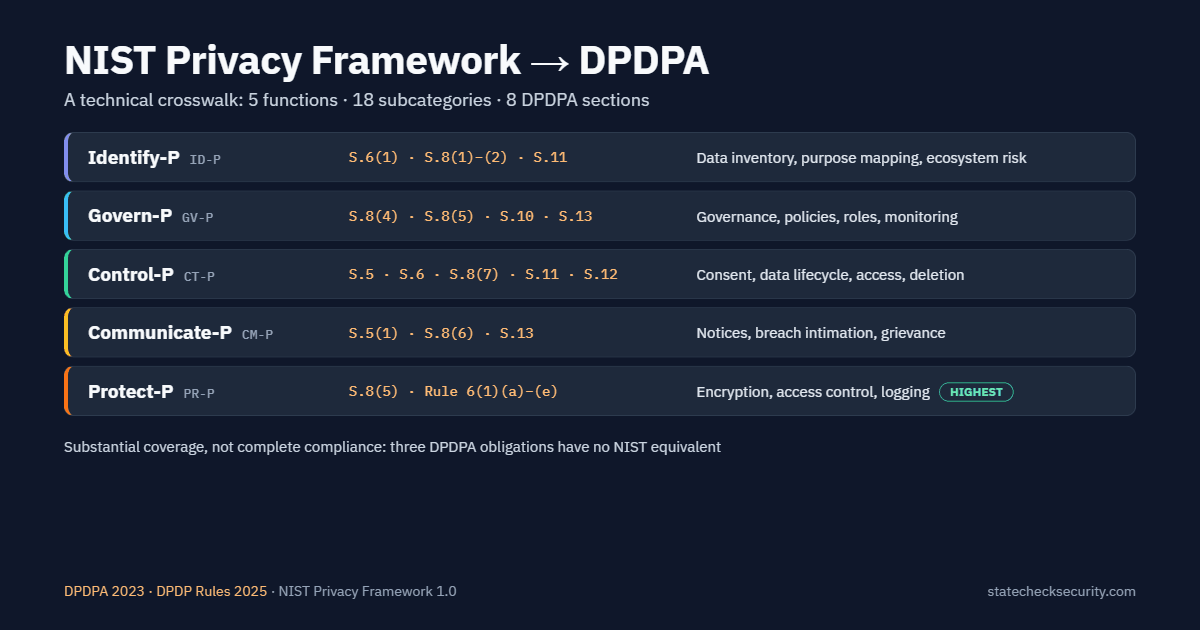
- The NIST Privacy Framework's five functions map to 18 subcategories across 8 DPDPA sections — substantial coverage but not complete compliance.
- Identify-P is the essential foundation: without a complete data processing inventory you cannot demonstrate purpose limitation (S.6(1)), answer access requests (S.11), or trigger erasure (S.8(7)).
- Protect-P has the highest coverage ratio — PR.DS-P1/P2 and PR.AC-P1/P4 directly satisfy Rule 6(1)(a)/(b) encryption and access-control mandates.
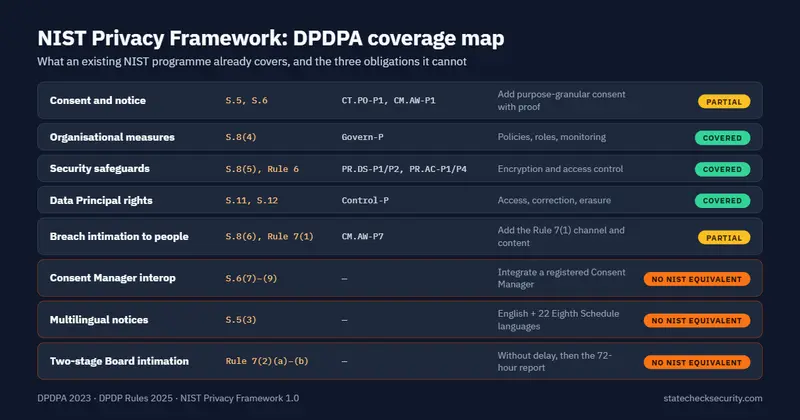
- Three DPDPA obligations have no NIST Privacy Framework equivalent: Consent Manager interoperability (S.6(7)-(9)), multilingual notice delivery (S.5(3)), and the two-stage Board breach intimation (Rule 7(2)(a)-(b)).
- Implementing NIST Privacy Framework does not guarantee DPDPA compliance — it provides governance scaffolding that must be extended with Act-specific controls for consent proof, Board reporting, and Significant Data Fiduciary (SDF) obligations.
- Organisations already certified to NIST CSF 2.0 or ISO 27001 can use the cross-framework tables in this article to avoid duplicating controls — the mappings are additive, not overlapping.
- The DPDPA's consent regime (S.6(1)) is more prescriptive than anything in NIST Privacy Framework: purpose-granular, verifiable, with a reversed burden of proof (S.6(10)).
Key terms: Data Fiduciary — entity determining the purpose and means of processing personal data (GDPR: Data Controller; NIST Privacy Framework: Organisation). NIST Privacy Framework — a voluntary, risk-based framework from NIST with five functions: Identify-P, Govern-P, Control-P, Communicate-P, Protect-P. Technical and Organisational Measures (TOMs) — measures required by Section 8(4); for security, Rule 6(1) sets the minimum safeguards, including encryption, access control, logging, and data backups. Significant Data Fiduciary (SDF) — a Data Fiduciary designated under Section 10 as high-risk, subject to additional DPO, DPIA, and independent-audit obligations.
Table of Contents
- Introduction
- The Legal Foundation: DPDPA Obligations in the Crosswalk
- The Core Crosswalk: NIST Privacy Framework Functions to DPDPA
- DPDPA vs. NIST Privacy Framework vs. GDPR: Comparison Table
- Identify-P: Building the Data Governance Foundation
- Govern-P: Establishing the Compliance Governance Structure
- Control-P: Managing the Data Lifecycle
- Communicate-P: Notices, Breach Reporting, and Grievance
- Protect-P: Security Safeguards Mapped to Rule 6
- Common Pitfalls and FAQ
- Key Takeaways
- Downloadable Resources
Introduction
Organisations that have adopted the NIST Privacy Framework for their global privacy programmes face a practical question as India's Digital Personal Data Protection Act, 2023 (DPDPA) enters enforcement: how much of this existing governance work carries over?
The answer is substantial -- but not complete. The NIST Privacy Framework was designed as a voluntary, risk-based tool for managing privacy risk across any jurisdiction. The DPDPA is a statutory regime with mandatory obligations, prescribed timelines, and penalties extending to two hundred and fifty crore rupees. The framework gives you the governance scaffolding; the Act fills it with specific, enforceable requirements.
This NIST Privacy Framework DPDPA mapping covers each of the Privacy Framework's five functions and the DPDPA obligations they address. It is written for security architects, privacy engineers, and compliance leads who need to translate an existing NIST-based programme into demonstrable DPDPA compliance -- or who are evaluating NIST as the governance backbone for a new DPDPA compliance initiative.
The focus is on the four functions most relevant to data governance and audit readiness: Identify-P, Govern-P, Control-P, and Communicate-P. We also cover Protect-P where it intersects with the DPDP Rules 2025's minimum security safeguards.
The Legal Foundation: DPDPA Obligations in the Crosswalk
Before mapping controls, we need to establish the DPDPA obligations that intersect with NIST Privacy Framework subcategories. Every section reference below is drawn from the Act's gazette text or the DPDP Rules 2025.
Consent and Notice (Sections 5 and 6)
The DPDPA requires Data Fiduciaries to obtain free, specific, informed, and unambiguous consent before processing personal data. Section 5(1) mandates that every consent request be accompanied by a notice describing the data collected, its purpose, and how the Data Principal can exercise her rights.
"The consent given by the Data Principal shall be free, specific, informed, unconditional and unambiguous with a clear affirmative action, and shall signify an agreement to the processing of her personal data for the specified purpose and be limited to such personal data as is necessary for such specified purpose." -- Section 6(1), DPDPA 2023
Section 6(4) grants the right to withdraw consent "with the ease of doing so being comparable to the ease with which such consent was given." Section 6(10) places the burden of proof on the Data Fiduciary to demonstrate that valid notice was given and consent obtained.
Reasonable Security Safeguards (Section 8(5) and Rule 6)
"A Data Fiduciary shall protect personal data in its possession or under its control, including in respect of any processing undertaken by it or on its behalf by a Data Processor, by taking reasonable security safeguards to prevent personal data breach." -- Section 8(5), DPDPA 2023
The DPDP Rules 2025 specify the minimum safeguards under Rule 6(1): encryption (Rule 6(1)(a)), access control (Rule 6(1)(b)), logging and monitoring (Rule 6(1)(c)), and one-year log retention (Rule 6(1)(e)).
Technical and Organisational Measures (Section 8(4))
"A Data Fiduciary shall implement appropriate technical and organisational measures to ensure effective observance of the provisions of this Act and the rules made thereunder." -- Section 8(4), DPDPA 2023
This provision creates a broad mandate for privacy governance -- exactly the territory where the NIST Privacy Framework operates.
Data Erasure (Section 8(7))
"A Data Fiduciary shall, unless retention is necessary for compliance with any law for the time being in force,— (a) erase personal data, upon the Data Principal withdrawing her consent or as soon as it is reasonable to assume that the specified purpose is no longer being served, whichever is earlier; and (b) cause its Data Processor to erase any personal data that was made available by the Data Fiduciary for processing to such Data Processor." -- Section 8(7), DPDPA 2023
Breach Notification (Section 8(6) and Rule 7)
Section 8(6) requires the Data Fiduciary to give the Board and each affected Data Principal intimation of a personal data breach "in such form and manner as may be prescribed". Rule 7 of the DPDP Rules 2025 prescribes two clocks. Each affected Data Principal gets an intimation "without delay" through her user account or registered mode of communication (Rule 7(1)), and the Board gets an initial description of the breach "without delay" (Rule 7(2)(a)). A detailed report to the Board follows "within seventy-two hours of becoming aware of the breach", or such longer period as the Board may allow on a written request (Rule 7(2)(b)). Rule 7 applies from 13 May 2027.
Data Principal Rights (Sections 11 and 12)
Section 11 grants Data Principals the right to a summary of their personal data and processing activities, including identities of all Data Fiduciaries and Data Processors with whom data has been shared. Section 12 provides rights to correction, completion, updating, and erasure.
Grievance Redressal (Section 13)
Data Fiduciaries must provide readily available means of grievance redressal (Section 13(1)) and respond within the prescribed period (Section 13(2)). Rule 14(3) requires you to publish that period, a reasonable period not exceeding 90 days, on your website or app, and to meet it.
Significant Data Fiduciary Obligations (Section 10)
Entities notified as Significant Data Fiduciaries must appoint a Data Protection Officer based in India, conduct periodic Data Protection Impact Assessments, and engage independent data auditors (Section 10(2)). Rule 13(1)-(2) makes the DPIA and audit an annual exercise, with a report of significant observations furnished to the Board.
The Core Crosswalk: NIST Privacy Framework Functions to DPDPA
The following table provides the high-level mapping between NIST Privacy Framework functions and DPDPA obligations. Detailed subcategory mappings follow in each function's section.
| NIST Function | Code | Key DPDPA Sections | Primary Use Case |
|---|---|---|---|
| Identify-P | ID-P | S.6(1), S.8(1)-(2), S.11 | Data inventory, purpose mapping, ecosystem risk |
| Govern-P | GV-P | S.8(4), S.8(5), S.10, S.13 | Governance structure, policies, roles, monitoring |
| Control-P | CT-P | S.5, S.6, S.8(7), S.11, S.12 | Consent, data lifecycle, access, deletion |
| Communicate-P | CM-P | S.5(1), S.8(6), S.13 | Notices, breach notification, grievance |
| Protect-P | PR-P | S.8(5), Rule 6(1)(a)-(e) | Encryption, access control, logging |
flowchart TD
    subgraph NIST["NIST Privacy Framework"]
        IDP["ID-P: Identify"]
        GVP["GV-P: Govern"]
        CTP["CT-P: Control"]
        CMP["CM-P: Communicate"]
        PRP["PR-P: Protect"]
    end

    subgraph DPDPA["DPDPA Obligations"]
        S56["S.5-6: Consent & Notice"]
        S84["S.8(4): Technical Measures"]
        S85["S.8(5): Security Safeguards"]
        S86["S.8(6): Breach Notification"]
        S87["S.8(7): Data Erasure"]
        S1112["S.11-12: Data Principal Rights"]
        S13["S.13: Grievance Redressal"]
        S10["S.10: SDF Obligations"]
    end

    IDP --> S56
    IDP --> S1112
    GVP --> S84
    GVP --> S85
    GVP --> S10
    CTP --> S56
    CTP --> S87
    CTP --> S1112
    CMP --> S56
    CMP --> S86
    CMP --> S13
    PRP --> S85

    style IDP fill:#e8f4fd,stroke:#1976d2
    style GVP fill:#e8f4fd,stroke:#1976d2
    style CTP fill:#e8f4fd,stroke:#1976d2
    style CMP fill:#e8f4fd,stroke:#1976d2
    style PRP fill:#e8f4fd,stroke:#1976d2
Alt Text: Flowchart showing five NIST Privacy Framework functions (Identify-P, Govern-P, Control-P, Communicate-P, Protect-P) mapped to eight DPDPA obligation areas including consent, security safeguards, breach notification, data erasure, data principal rights, and grievance redressal.
DPDPA vs. NIST Privacy Framework vs. GDPR: Comparison Table
This comparison surfaces the most important structural differences across the three frameworks for organisations that operate multi-jurisdiction privacy programmes.
| Dimension | DPDPA 2023 | NIST Privacy Framework | GDPR |
|---|---|---|---|
| Legal nature | Mandatory statute (India) | Voluntary risk framework (global) | Mandatory regulation (EU/EEA) |
| Consent model | Affirmative, purpose-granular, reversible (S.6) | Not prescribed — framework-neutral | Freely given, specific, informed, unambiguous (Art. 7) |
| Consent burden of proof | Data Fiduciary (S.6(10)) | Not addressed | Data Controller (Art. 7(1)) |
| Consent withdrawal | "Ease comparable to giving" (S.6(4)) | Not addressed | "As easy to withdraw as to give" (Art. 7(3)) |
| Sensitive data category | None — no special category in Act (S.9 = children and persons with disability who have a lawful guardian) | Risk-tiered by framework user | Special categories (Art. 9): health, biometric, racial, etc. |
| Data minimisation | S.6(1) purpose-limitation implied | CT.DP-P1 | Art. 5(1)(c) explicit obligation |
| Data erasure trigger | Consent withdrawal or purpose completion (S.8(7)) | CT.DM-P5 (policy-driven) | Right to erasure on request (Art. 17) |
| Breach notification — individuals | "Without delay" (Rule 7(1), under S.8(6)) | CM.AW-P7 (notification mechanism) | "Without undue delay" (Art. 34) |
| Breach notification — regulator | Two clocks: initial intimation to the Board "without delay" (Rule 7(2)(a)), then a detailed report within 72 hours of becoming aware, extendable by the Board on written request (Rule 7(2)(b)) | No equivalent — DPDPA-specific | 72 hours to supervisory authority (Art. 33) |
| Governance mandate | S.8(4) TOMs — broad obligation | GV-P function — voluntary | Art. 24/25 — accountability + privacy by design |
| DPO requirement | SDFs only, India-based (S.10(2)(a)) | GV.PO-P3 (role assignment) — voluntary | Mandatory for certain controllers (Art. 37) |
| Cross-border transfers | Negative-list model — permitted unless blocked by Central Govt. (S.16) | Not addressed | Adequacy/SCCs/BCRs required (Art. 46) |
| Independent audit | SDFs only (S.10(2)(b)) | GV.MT-P3 (assessment) — voluntary | Art. 28 processor audit rights (not mandatory DPA audit) |
| Grievance redressal | Mandatory mechanism; response within a reasonable period not exceeding 90 days (S.13, Rule 14(3)) | CM.AW-P2 | Art. 77 right to lodge complaint with supervisory authority |
| Children's data | Verifiable parental consent, with due diligence that the parent is an identifiable adult (S.9(1), Rule 10) | ID.RA-P3 (risk assessment) | Art. 8 — 16-year age threshold (member-state variable) |
| Penalties | Up to ₹250 crore per breach (Schedule, S.33(1)) | None — voluntary framework | Up to €20M or 4% global turnover |
Key structural difference: DPDPA has no "sensitive personal data" category — this is the most common misconception from GDPR practitioners. Section 9 applies only to children and to persons with disability who have a lawful guardian. All other personal data is governed uniformly by Section 8(5). NIST Privacy Framework's risk-tiering approach does not map to DPDPA's flat treatment of personal data categories.
What Does NIST Privacy Framework Require for DPDPA Compliance?
The NIST Privacy Framework provides a governance vocabulary and control structure, but it is the DPDPA that supplies the mandatory obligations. Organisations asking "does our NIST programme satisfy DPDPA?" should evaluate three dimensions:
- Direct coverage — NIST subcategory objective matches DPDPA section obligation exactly.
- Partial coverage — NIST subcategory addresses the same domain but lacks DPDPA's statutory specificity.
- Gap — DPDPA obligation has no NIST Privacy Framework equivalent.
This crosswalk uses that three-level classification across all five functions.
Identify-P: Building the Data Governance Foundation
The Identify-P function establishes organisational understanding of privacy risk arising from data processing. For DPDPA compliance, this is where you build the data inventory that underpins every other obligation.
Subcategory Crosswalk: Identify-P to DPDPA
| NIST Subcategory | Description | DPDPA Section | DPDPA Obligation | Coverage |
|---|---|---|---|---|
| ID.IM-P1 | Inventory of systems processing data | S.8(4) | Technical measures for compliance | Full |
| ID.IM-P5 | Inventory of purposes for data actions | S.6(1) | Purpose limitation and consent | Full |
| ID.IM-P8 | Data processing mapping | S.11(1)(b) | Data Principal right to processing summary | Full |
| ID.DE-P1 | Ecosystem risk management policies | S.8(1)-(2) | Data Processor governance | Partial |
| ID.DE-P3 | Contracts with ecosystem parties | S.8(2) | Valid contract for Data Processors | Full |
| ID.DE-P5 | Routine assessment of ecosystem parties | Rule 6(1)(f) | Processor security assurance | Partial |
| ID.RA-P3 | Identify problems for individuals | S.10(2)(c) | DPIA for Significant Data Fiduciaries | Partial |
Where Identify-P satisfies DPDPA directly: If you maintain a complete data processing inventory under ID.IM-P1 through ID.IM-P8, you have the foundation for Section 11 compliance -- the ability to tell any Data Principal exactly what personal data you hold, why, and who has access. You also satisfy the precondition for Section 6(1) purpose limitation: you cannot limit data collection to what is necessary for a specified purpose if you have not inventoried what purposes exist.
Where Identify-P needs DPDPA extension: ID.DE-P1 establishes ecosystem risk management policies, but DPDPA Section 8(1) goes further: the Data Fiduciary remains liable for compliance even when processing is delegated to a Data Processor. Your ecosystem risk management must include DPDPA-specific contractual clauses per Rule 6(1)(f), not just general security requirements.
Implementation Pattern: Purpose-Bound Data Inventory
# Data processing inventory schema (implements ID.IM-P5 + Section 6(1))
# Store as structured data in your CMDB or data catalogue
data_processing_inventory:
  - system_id: "crm-prod-01"
    system_name: "Customer Relationship Management"
    data_elements:
      - field: "email_address"
        classification: "personal_data_dpdpa"
        purpose_keys: ["service_delivery", "support_communication"]
      - field: "phone_number"
        classification: "personal_data_dpdpa"
        purpose_keys: ["two_factor_auth"]
    data_processors:
      - processor_name: "CloudCRM Inc."
        contract_reference: "DPA-2025-047"
        dpdpa_clauses_included: true
        last_audit_date: "2025-11-15"
    retention_policy:
      default_days: 365
      erasure_triggers: ["consent_withdrawal", "purpose_completion", "inactivity_threshold"]
    geographic_scope: ["IN", "US"]
This inventory schema maps directly to three NIST subcategories (ID.IM-P1, ID.IM-P5, ID.IM-P8) and simultaneously satisfies DPDPA requirements for purpose limitation (Section 6(1)), Data Processor governance (Section 8(2)), and Data Principal access requests (Section 11).
Govern-P: Establishing the Compliance Governance Structure
The Govern-P function develops the organisational governance needed for ongoing privacy risk management. For DPDPA, this is where your policies, roles, and monitoring processes live.
Subcategory Crosswalk: Govern-P to DPDPA
| NIST Subcategory | Description | DPDPA Section | DPDPA Obligation | Coverage |
|---|---|---|---|---|
| GV.PO-P1 | Privacy values and policies established | S.8(4) | Technical and organisational measures | Full |
| GV.PO-P3 | Privacy roles and responsibilities | S.10(2)(a) | DPO appointment (SDF) | Partial |
| GV.PO-P5 | Legal/regulatory requirements managed | S.8(4), S.8(5) | Compliance with Act and Rules | Full |
| GV.AT-P1 | Workforce trained on privacy policies | S.8(4) | Organisational measures | Full |
| GV.MT-P1 | Privacy risk re-assessed ongoing | S.10(2)(c) | Periodic DPIA (SDF) | Partial |
| GV.MT-P3 | Compliance assessment procedures | S.10(2)(b) | Independent data audit (SDF) | Partial |
| GV.MT-P7 | Complaint handling established | S.13 | Grievance redressal mechanism | Full |
Where Govern-P satisfies DPDPA directly: GV.PO-P5 (understanding legal requirements) and GV.PO-P1 (establishing privacy policies) together form the governance backbone for Section 8(4) compliance. If your NIST governance programme already tracks Indian regulatory requirements and translates them into organisational policy, you have a defensible Section 8(4) posture.
GV.MT-P7 maps directly to Section 13's grievance redressal requirement. If you have implemented a complaint handling mechanism under NIST, extend it to meet the prescribed response period: a reasonable period not exceeding 90 days (Rule 14(3)).
Where Govern-P needs DPDPA extension: GV.PO-P3 assigns privacy roles, but DPDPA Section 10(2)(a) requires Significant Data Fiduciaries to appoint a Data Protection Officer who is based in India and answers to the Board of Directors. This is a statutory appointment, not a voluntary role assignment.
GV.MT-P3 covers compliance assessment, but Section 10(2)(b) mandates that SDFs engage an independent data auditor -- not just internal compliance reviews -- and Rule 13(1) requires the DPIA and audit once in every twelve months. Your NIST monitoring programme must be extended with an external audit track for SDF obligations.
Implementation Pattern: DPDPA Governance Policy-as-Code
# Governance configuration (implements GV.PO-P1, GV.PO-P5 + Section 8(4))
# Enforced via policy engine (e.g., OPA/Rego, AWS Config Rules)

DPDPA_GOVERNANCE_CONFIG = {
    "regulatory_framework": "DPDPA_2023",
    "rules_version": "DPDP_Rules_2025",

    # GV.PO-P3 + Section 10(2)(a): DPO Configuration
    "dpo_config": {
        "required": True,  # Set True if notified as SDF
        "jurisdiction": "IN",
        "reports_to": "board_of_directors",
        "contact_published": True,
    },

    # GV.MT-P1 + Section 10(2)(c): DPIA Schedule
    "dpia_schedule": {
        "frequency_months": 12,
        "trigger_events": [
            "new_processing_activity",
            "significant_change_to_existing",
            "new_data_processor_engagement",
        ],
        "assessor": "independent",  # SDF requirement
    },

    # GV.MT-P3 + Section 10(2)(b): Audit Configuration
    "audit_config": {
        "independent_audit_required": True,  # SDF requirement
        "audit_frequency_months": 12,
        "audit_scope": [
            "consent_management",
            "security_safeguards",
            "data_principal_rights",
            "breach_notification_readiness",
            "data_processor_governance",
        ],
    },

    # GV.MT-P7 + Section 13: Grievance Mechanism
    "grievance_config": {
        "mechanism_type": "web_portal_and_email",
        "response_sla_days": 30,  # Internal target; Rule 14(3) ceiling is 90 days
        "escalation_to_board": True,
        "published_in_notice": True,
    },
}
Cross-Framework Alignment: Govern-P to ISO 27001 and SOC 2
Organisations maintaining multiple frameworks can consolidate governance controls. The table below shows how Govern-P subcategories map across all three frameworks:
| NIST Govern-P | ISO 27001:2022 | SOC 2 TSC | DPDPA Section |
|---|---|---|---|
| GV.PO-P1 | A.5.1 (Policies for information security) | CC1.1 (Integrity and ethical values) | S.8(4) |
| GV.PO-P3 | A.5.2 (Roles and responsibilities) | CC1.3 (Structures and authorities) | S.10(2)(a) |
| GV.PO-P5 | A.5.31 (Legal requirements) | CC3.1 (Objectives clarity) | S.8(4), S.8(5) |
| GV.MT-P3 | A.5.35 (Independent review) | CC4.1 (Monitoring activities) | S.10(2)(b) |
| GV.MT-P7 | -- (Gap) | -- (Gap) | S.13 |
Note that Section 13 grievance redressal has no direct counterpart in either ISO 27001 or SOC 2. This is a DPDPA-specific control that must be implemented regardless of your existing framework portfolio.
Control-P: Managing the Data Lifecycle
The Control-P function addresses the granular data management capabilities that DPDPA demands: consent, access, correction, deletion, and purpose enforcement.
Subcategory Crosswalk: Control-P to DPDPA
| NIST Subcategory | Description | DPDPA Section | DPDPA Obligation | Coverage |
|---|---|---|---|---|
| CT.PO-P1 | Consent mechanisms developed | S.6(1), S.6(4) | Purpose-granular consent, withdrawal | Partial |
| CT.PO-P3 | Consent administration managed | S.6(7)-(9) | Consent Manager integration | Partial |
| CT.PO-P4 | Data lifecycle managed per authorised processing | S.8(7) | Erasure on purpose completion | Full |
| CT.DM-P1 | Data accessible for review | S.11 | Data Principal access right | Full |
| CT.DM-P3 | Data accessible for alteration | S.12 | Right to correction | Full |
| CT.DM-P4 | Data accessible for deletion | S.12 | Right to erasure | Full |
| CT.DM-P5 | Data destroyed according to policy | S.8(7) | Proactive erasure obligation | Full |
| CT.DM-P8 | Audit/log records with data minimisation | Rule 6(1)(c),(e) | Logging with 1-year retention | Partial |
| CT.DP-P1 | Data processed to limit observability | S.6(1) | Data minimisation | Full |
| CT.DP-P2 | De-identification techniques applied | S.8(5) | Security safeguards | Full |
Where Control-P satisfies DPDPA directly: The CT.DM subcategories (Data Management) are a strong match for DPDPA's data principal rights. If you have implemented CT.DM-P1 through CT.DM-P4, you already have the technical capability to handle Section 11 access requests, Section 12 correction requests, and Section 12 erasure requests. CT.DM-P5 and CT.PO-P4 together provide the data lifecycle management that Section 8(7) demands.
Where Control-P needs DPDPA extension: CT.PO-P1 provides generic consent mechanisms, but DPDPA Section 6(1) requires purpose-granular consent with verifiable proof (Section 6(10) burden of proof). Your NIST consent implementation must be extended with immutable audit trails and multilingual notice delivery per Section 5(3).
CT.DM-P8 addresses audit logging with a data minimisation principle, but Rule 6(1)(e) prescribes a specific one-year retention floor. Your log retention configuration must meet this statutory minimum regardless of your organisation's general data minimisation preferences.
Implementation Pattern: Data Subject Rights API (Control-P to DPDPA)
# Data Principal Rights service (implements CT.DM-P1 through P4 + Sections 11, 12)
from datetime import datetime, timedelta, timezone
from enum import Enum
from typing import Optional
import uuid


class RightType(Enum):
    ACCESS = "access"           # Section 11 - CT.DM-P1
    CORRECTION = "correction"   # Section 12 - CT.DM-P3
    ERASURE = "erasure"         # Section 12 - CT.DM-P4
    NOMINATION = "nomination"   # Section 14


class RequestStatus(Enum):
    RECEIVED = "received"
    VALIDATING = "validating"
    PROCESSING = "processing"
    COMPLETED = "completed"
    REJECTED = "rejected"


class DPDPARightsService:
    """
    Implements DPDPA Data Principal rights mapped to NIST Control-P subcategories.
    Each method traces to both the NIST subcategory and the DPDPA section it satisfies.
    """

    def handle_access_request(
        self, principal_id: str
    ) -> dict:
        """
        NIST: CT.DM-P1 (data accessible for review)
        DPDPA: Section 11 -- summary of personal data and processing activities

        Returns: summary including all data elements, purposes, and downstream
        processors/fiduciaries (required by Section 11(1)(b)).
        """
        request_id = str(uuid.uuid4())
        # Query data processing inventory (built under ID.IM-P8)
        data_summary = self._compile_data_summary(principal_id)
        processor_list = self._get_downstream_entities(principal_id)

        return {
            "request_id": request_id,
            "right_type": RightType.ACCESS.value,
            "status": RequestStatus.COMPLETED.value,
            "data_summary": data_summary,
            "processors_and_fiduciaries": processor_list,  # S.11(1)(b)
            "generated_at": datetime.now(timezone.utc).isoformat(),
        }

    def handle_erasure_request(
        self, principal_id: str, reason: str
    ) -> dict:
        """
        NIST: CT.DM-P4 (data accessible for deletion) + CT.DM-P5 (destroyed per policy)
        DPDPA: Section 8(7) -- erasure on consent withdrawal or purpose completion
               Section 12 -- right to erasure on request

        Triggers cascading delete across all systems in the data inventory.
        Preserves audit record of the erasure event (CT.DM-P8 + Rule 6(1)(c)).
        """
        request_id = str(uuid.uuid4())
        # Identify all systems holding this principal's data (ID.IM-P1)
        affected_systems = self._get_systems_for_principal(principal_id)

        # Check legal retention holds before erasure
        retention_holds = self._check_retention_holds(principal_id)

        erasure_results = []
        for system in affected_systems:
            if system["system_id"] not in retention_holds:
                result = self._execute_erasure(system, principal_id)
                erasure_results.append(result)

        # Log the erasure event -- retained for 1 year per Rule 6(1)(e)
        self._log_erasure_audit(request_id, principal_id, erasure_results)

        return {
            "request_id": request_id,
            "right_type": RightType.ERASURE.value,
            "status": RequestStatus.COMPLETED.value,
            "systems_erased": len(erasure_results),
            "retention_holds": len(retention_holds),
            "completed_at": datetime.now(timezone.utc).isoformat(),
        }

    # Private methods omitted for brevity -- see full implementation
    # in the StateCheck DPDPA Toolkit (open-source, coming Q3 2026)
    def _compile_data_summary(self, principal_id: str) -> dict: ...
    def _get_downstream_entities(self, principal_id: str) -> list: ...
    def _get_systems_for_principal(self, principal_id: str) -> list: ...
    def _check_retention_holds(self, principal_id: str) -> list: ...
    def _execute_erasure(self, system: dict, principal_id: str) -> dict: ...
    def _log_erasure_audit(self, req_id: str, pid: str, results: list) -> None: ...
Communicate-P: Notices, Breach Reporting, and Grievance
The Communicate-P function covers how organisations inform individuals about data processing and privacy risks. This maps directly to three of DPDPA's most operationally demanding obligations.
Subcategory Crosswalk: Communicate-P to DPDPA
| NIST Subcategory | Description | DPDPA Section | DPDPA Obligation | Coverage |
|---|---|---|---|---|
| CM.AW-P1 | Notices and privacy policies established | S.5(1) | Consent notice requirements | Partial |
| CM.AW-P2 | Complaint mechanisms established | S.13 | Grievance redressal | Full |
| CM.AW-P4 | Records of data disclosures maintained | S.11(1)(b) | Disclosure of downstream sharing | Full |
| CM.AW-P5 | Corrections/deletions communicated | S.12 | Propagation of corrections | Partial |
| CM.AW-P7 | Breach notification to individuals | S.8(6), Rule 7(1) | Data Principal breach notification | Partial |
| CM.AW-P8 | Mitigation mechanisms for individuals | Rule 7(1)(c),(d) | Breach mitigation guidance | Full |
Where Communicate-P satisfies DPDPA directly: CM.AW-P2 maps cleanly to Section 13 grievance redressal. CM.AW-P4 supports Section 11(1)(b)'s requirement to disclose downstream sharing. CM.AW-P8 aligns with Rule 7(1)(c) and (d), which require the Data Principal intimation to describe the measures the Data Fiduciary has implemented to mitigate risk and the safety measures she may take to protect her interests.
Where Communicate-P needs DPDPA extension: CM.AW-P1 addresses privacy notices generally, but Section 5(1) prescribes specific content (data collected, purpose, rights exercise methods) and Section 5(3) requires notices in English or any Eighth Schedule language. Your NIST notice mechanism needs a multilingual delivery layer.
CM.AW-P7 covers breach notification to individuals, and Rule 7(1) specifies the channel ("through her user account or any mode of communication registered by her with the Data Fiduciary") and the content: a description of the breach (nature, extent and timing), the likely consequences for her, the mitigation measures taken, the safety measures she may take, and business contact information for queries. The Board track under Rule 7(2) is separate. The initial intimation "without delay" must describe the breach, including its nature, extent, timing and location of occurrence and the likely impact (Rule 7(2)(a)). The detailed report within 72 hours must add updated information, the facts and reasons leading to the breach, mitigation measures, any findings on the person who caused it, remedial measures to prevent recurrence, and a report on the intimations given to Data Principals (Rule 7(2)(b)). This Board reporting track has no direct NIST subcategory equivalent and must be built as a DPDPA-specific extension.
Implementation Pattern: Breach Notification Workflow
sequenceDiagram
    participant SIEM
    participant Triage as Triage Engine
    participant DP as Data Principal<br/>Notification (CM.AW-P7)
    participant Board as Board Notification<br/>(DPDPA-specific)
    participant Audit as Audit Log<br/>(CT.DM-P8)

    SIEM->>Triage: Security event detected
    Triage->>Triage: Classify as personal data breach<br/>(Section 2(u) criteria)
    Triage->>DP: Tier 1: Notify affected Data Principals<br/>"without delay" (Rule 7(1))
    Triage->>Board: Tier 2a: Initial intimation to Board<br/>"without delay" (Rule 7(2)(a))
    Triage->>Audit: Log breach event + all actions
    Note over Board: Clock: 72 h from awareness<br/>(extendable on written request)
    Triage->>Board: Tier 2b: Detailed report within 72 h<br/>(Rule 7(2)(b)(i)-(vi))
    Audit->>Audit: Retain all records >= 1 year<br/>(Rule 6(1)(e))
Alt Text: Sequence diagram showing the DPDPA breach notification workflow from SIEM detection through triage, parallel notification "without delay" to Data Principals (Rule 7(1)) and the Data Protection Board (Rule 7(2)(a)), with audit logging at each stage and a detailed Board report within 72 hours (Rule 7(2)(b)).
Protect-P: Security Safeguards Mapped to Rule 6
The Protect-P function covers data processing safeguards -- the technical security controls that underpin Section 8(5)'s "reasonable security safeguards."
Subcategory Crosswalk: Protect-P to DPDPA
| NIST Subcategory | Description | DPDPA Section | DPDPA Obligation | Coverage |
|---|---|---|---|---|
| PR.AC-P1 | Identity and credential management | Rule 6(1)(b) | Access control measures | Full |
| PR.AC-P4 | Least privilege and separation of duties | Rule 6(1)(b) | Access control measures | Full |
| PR.DS-P1 | Data-at-rest protected | Rule 6(1)(a) | Encryption | Full |
| PR.DS-P2 | Data-in-transit protected | Rule 6(1)(a) | Encryption | Full |
| PR.DS-P5 | Data leakage protections | S.8(5) | Prevent personal data breach | Full |
| PR.PO-P7 | Response and recovery plans | S.8(6), Rule 7 | Breach response capability | Partial |
Protect-P is the function with the highest coverage ratio against DPDPA. If you have implemented NIST Privacy Framework Protect-P subcategories with production-grade controls, your Section 8(5) and Rule 6 posture is strong.
The one extension needed: PR.PO-P7 covers incident response and recovery plans but does not prescribe the specific notification channels, content and clocks that Rule 7 demands. Your response plan must include DPDPA-specific playbook steps for the initial Board intimation "without delay" (Rule 7(2)(a)) and the detailed 72-hour report (Rule 7(2)(b)).
Cross-Framework Mapping: Protect-P to CSF 2.0 and ISO 27001
| NIST Privacy Framework | NIST CSF 2.0 | ISO 27001:2022 | DPDPA Rule |
|---|---|---|---|
| PR.DS-P1 (Data-at-rest) | PR.DS-01 | A.8.24 (Cryptography) | Rule 6(1)(a) |
| PR.DS-P2 (Data-in-transit) | PR.DS-02 | A.8.24 (Cryptography) | Rule 6(1)(a) |
| PR.AC-P4 (Least privilege) | PR.AA-05 | A.5.15 (Access control) | Rule 6(1)(b) |
| PR.AC-P1 (Credentials) | PR.AA-01 | A.5.16 (Identity management) | Rule 6(1)(b) |
| PR.PO-P7 (Response plans) | RS.MA-01 | A.5.24 (Incident management) | Rule 7 |
This cross-framework table allows organisations with NIST CSF and ISO 27001 certifications to trace their existing controls through the Privacy Framework crosswalk to DPDPA obligations. For detailed ISO 27001 mappings, see our DPDPA to ISO 27001 Mapping Guide.
Common Pitfalls and FAQ
Does implementing NIST Privacy Framework satisfy DPDPA compliance?
No. The NIST Privacy Framework is a voluntary governance tool; the DPDPA is a statutory regime with mandatory obligations and penalties. The framework provides structure and governance discipline, but you must layer DPDPA-specific requirements on top -- particularly around consent proof (Section 6(10)), multilingual notices (Section 5(3)), Board breach intimation (Rule 7(2)(a)-(b)), and Consent Manager interoperability (Section 6(7)-(9)).
How do the NIST Privacy Framework's five functions map to DPDPA?
Each function maps at varying levels of coverage. Protect-P has the highest direct coverage -- its encryption and access-control subcategories satisfy Rule 6(1)(a) and (b) almost entirely. Control-P is strong for data principal rights (Sections 11 and 12). Identify-P provides the inventory foundation required for purpose limitation and erasure. Govern-P satisfies the broad Section 8(4) TOMs mandate. Communicate-P covers notice and breach notification but needs DPDPA extensions for multilingual delivery and the Board reporting track. Across all five functions, 18 subcategories map to DPDPA obligations, with three DPDPA obligations having no NIST equivalent at all.
What DPDPA obligations have no NIST Privacy Framework equivalent?
Three obligations require net-new controls outside any NIST subcategory: (1) Consent Manager interoperability under Section 6(7)-(9), which requires technical integration with a registered Consent Manager for managing consent records; (2) multilingual notice delivery under Section 5(3), which requires notices in English or any of the 22 Eighth Schedule languages; and (3) the Board breach intimation under Rule 7(2), which runs on two clocks — an initial description "without delay" (nature, extent, timing, location, likely impact) and a detailed report within 72 hours (facts and reasons, mitigation, findings on who caused the breach, remedial measures, and a report on intimations to Data Principals) — that go beyond generic incident response plans.
Does DPDPA require breach notification within 72 hours?
Partly. The Act itself sets no hour count: Section 8(6) leaves the form and manner to the Rules. Rule 7 of the DPDP Rules 2025 then sets two clocks. The initial intimation goes to each affected Data Principal (Rule 7(1)) and to the Data Protection Board (Rule 7(2)(a)) "without delay" (note the wording, which differs from the GDPR Article 33 formula). The detailed report to the Board is due "within seventy-two hours of becoming aware of the breach", or within a longer period the Board allows on a written request (Rule 7(2)(b)). So 72 hours is the deadline for the detailed Board report, not for the first alert, which must go out sooner. Build the playbook around both clocks. Rule 7 applies from 13 May 2027.
How does NIST Privacy Framework differ from NIST CSF for DPDPA purposes?
The NIST CSF 2.0 focuses primarily on cybersecurity risk management and maps most directly to Section 8(5) and Rule 6(1) security safeguards. The NIST Privacy Framework adds the Identify-P, Control-P, and Communicate-P functions that address privacy-specific obligations CSF 2.0 does not cover -- including consent management, data principal rights, and privacy governance. For DPDPA compliance, you need both: CSF 2.0 covers the security safeguard layer and the Privacy Framework covers the data governance layer. They share the Protect function, allowing a single control implementation to satisfy both and the corresponding DPDPA obligations.
How does DPDPA compare to GDPR in its approach to privacy frameworks like NIST?
Both DPDPA and GDPR are technology-neutral statutes that do not mandate a specific compliance framework. However, GDPR's accountability principle (Article 5(2)) has generated extensive guidance on using ISO 27001 and NIST frameworks as evidence of compliance. DPDPA is newer and its regulatory guidance is still developing. The most significant structural difference for NIST practitioners: GDPR has explicit special-category personal data (health, biometric, racial origin, etc.) that requires additional safeguards. DPDPA has no equivalent special categories -- Section 9 applies only to children's data, and all adult personal data is governed uniformly. NIST Privacy Framework risk-tiering based on data sensitivity does not map directly to DPDPA's flat treatment of personal data.
Which NIST Privacy Framework function should we implement first for DPDPA readiness?
Start with Identify-P. Without a complete data processing inventory (ID.IM-P1 through ID.IM-P8), you cannot demonstrate compliance with purpose limitation (Section 6(1)), respond to data principal access requests (Section 11), or trigger erasure workflows (Section 8(7)). Every other function depends on knowing what data you hold, why, and where.
We are not a Significant Data Fiduciary. Do the Section 10 mappings still apply?
Section 10 obligations (DPO, DPIA, independent audit) apply only to entities notified as SDFs. However, implementing the corresponding NIST subcategories (GV.PO-P3, GV.MT-P1, GV.MT-P3) as voluntary governance controls strengthens your Section 8(4) posture and prepares you if your organisation is later notified as an SDF.
What audit evidence should we prepare using this crosswalk?
For each NIST subcategory mapped to a DPDPA obligation, maintain: (1) the policy document implementing the subcategory, (2) configuration evidence showing the technical control is active, (3) log evidence showing the control operates continuously, and (4) a traceability record linking the NIST subcategory to the specific DPDPA section. This four-layer evidence stack is what an independent auditor or the Data Protection Board will evaluate.
Key Takeaways
- The NIST Privacy Framework's five functions cover 18 subcategories that map to DPDPA obligations across 8 sections of the Act and Rules.
- Identify-P provides the data inventory foundation. Without it, you cannot demonstrate purpose limitation, respond to access requests, or trigger erasure.
- Govern-P satisfies Section 8(4)'s mandate for technical and organisational measures. Extend it with DPDPA-specific DPO, DPIA, and audit requirements for SDFs.
- Control-P covers data lifecycle management -- consent, access, correction, deletion -- which maps directly to Sections 6, 8(7), 11, and 12.
- Communicate-P addresses notice and breach notification, but needs DPDPA extensions for multilingual delivery (Section 5(3)) and Board reporting (Rule 7(2)(a)-(b)).
- Protect-P has the highest coverage ratio, with PR.DS-P1/P2 and PR.AC-P1/P4 directly satisfying Rule 6(1)(a) and (b).
- Three DPDPA obligations have no NIST Privacy Framework equivalent: Consent Manager interoperability (Section 6(7)-(9)), multilingual notice delivery (Section 5(3)), and the two-stage Board breach intimation (Rule 7(2)(a)-(b)). These require net-new controls.
- Use cross-framework tables to consolidate NIST PF, CSF 2.0, ISO 27001, and SOC 2 controls into a single compliance matrix. The mappings are additive, not duplicative.
📊 NIST-to-DPDPA Mapping Matrix (CSV)
Complete crosswalk of all 36 NIST Privacy Framework subcategories to DPDPA sections, with coverage levels, implementation notes, and cross-references to ISO 27001:2022, SOC 2 TSC, and NIST CSF 2.0. Import into Excel or Google Sheets for gap analysis and audit evidence tracking.
Download Mapping Matrix (CSV) | 36 controls × 10 columns
✅ Implementation Checklist
26-week phased implementation guide with pre-assessment questionnaire, phase-by-phase deliverables, SDF-specific tracks, and sign-off section. Use as a project plan template for gap remediation.
Download Implementation Checklist (Markdown) | 700+ lines
💻 Production-Ready Code Templates
- Data Inventory Schema (YAML) — Template for data processing inventory implementing ID.IM-P1/P5/P8
- Governance Configuration (Python) — Policy-as-code for DPDPA governance with SDF/non-SDF configs
- Data Subject Rights Service (Python/FastAPI) — REST API for Section 11 access, Section 12 correction/erasure
Browse Code Templates | MIT License
📄 Quick Reference Card
1-page condensed guide covering core mappings, top 10 controls, critical timelines, DPDPA-specific gaps, and common pitfalls. Print for desk reference during implementation sprints.
Download Quick Reference (Markdown/PDF) | Printable
All resources are open-source and production-ready. Use them to accelerate compliance, reduce audit costs, and demonstrate engineering rigor to regulators.
Next Steps
Completing a NIST Privacy Framework DPDPA mapping requires methodical gap analysis across all five functions. The crosswalk tables in this article identify where your existing NIST programme satisfies DPDPA and where extensions are needed.
Start with a gap assessment. StateCheck Security provides a free DPDPA readiness assessment that maps your current NIST Privacy Framework implementation to DPDPA obligations, identifies the extensions required, and delivers a prioritised remediation roadmap.
Request Your Free DPDPA Assessment
Related Articles
- The DPDPA to ISO 27001 Mapping Guide: Leveraging Annex A for Privacy Compliance -- If you maintain ISO 27001:2022, this control-by-control crosswalk shows where Annex A covers DPDPA and where it falls short.
- SOC 2 Privacy Criteria vs. DPDPA: Bridging the Gap for Indian SaaS Companies -- For organisations with SOC 2 Type II, this comparison maps Trust Services Criteria to DPDPA obligations with a detailed gap analysis.
- DPDPA Breach Notification: Automating SIEM Alerts to Legal Workflows -- Deep dive into the Rule 7 breach intimation obligations and the engineering architecture for automated breach response.
- Implementing Cryptographic Controls for DPDPA: Encryption Standards at Rest and in Transit -- The engineering specification for Rule 6(1)(a) compliance covering TLS 1.3, AES-256, and cloud KMS.