
Engineering Privacy by Design: Implementing DPDPA at the CI/CD Pipeline
Key Takeaways
- Section 8(4) of the DPDPA is the statutory mandate for privacy by design: it requires Data Fiduciaries to implement "appropriate technical and organisational measures" — automated CI/CD gates are a direct fulfilment of this obligation, not optional engineering hygiene.
- Shift left on compliance: detecting PII exposure, missing encryption, or inadequate erasure capability at commit time costs a fraction of remediating the same issues in production — or post-breach.
- Three pipeline gates cover the critical surface area: Gate 1 (SAST + secrets) catches code-level violations, Gate 2 (IaC policy) catches infrastructure misconfigurations, Gate 3 (deployment checks) validates application-level requirements before any code reaches production.
- Privacy reviews do not have to slow down deployments — the gates in this guide are fully automated, run in parallel with existing CI jobs, and block only on clear violations. False-positive management is built in with suppression audit trails.
- Policy-as-code (OPA/Rego) turns Rule 6(1) requirements — encryption at rest, log retention, access control — into machine-enforceable assertions that run on every Terraform plan before infrastructure changes are applied.
- Consent API integration testing belongs in Gate 3: verifying that every data-collecting endpoint has a corresponding purpose declaration enforces Section 6(1) data minimisation in code, not just in policy documents.
- Pipeline compliance reports generated at Gate 3 are audit evidence for Data Protection Board inquiries under Section 8(4) and Rule 6(1)(g). Keep them alongside the logs they relate to: Rule 6(1)(e) and Rule 8(3) set a one-year minimum for processing logs.
Key terms: Data Fiduciary — entity determining purpose and means of processing (GDPR equivalent: Data Controller). Privacy by Design — the principle of embedding privacy protections into system architecture from the outset rather than retrofitting them. Section 8(4) — DPDPA obligation requiring Data Fiduciaries to implement "appropriate technical and organisational measures to ensure effective observance of the provisions of this Act." Technical and Organisational Measures (TOMs) — the enumerated minimum security controls in Rule 6(1)(a)-(g). PII Scanner — a tool that statically analyses code or data for patterns matching personal data (names, emails, phone numbers, Aadhaar numbers). Significant Data Fiduciary (SDF) — a Data Fiduciary notified by the Central Government under Section 10(1) as carrying higher-risk processing, subject to additional obligations including Rule 13(3) algorithmic due diligence.
Table of Contents
- What Does Section 8(4) Require in Your CI/CD Pipeline?
- The Engineering Translation: Framework Controls for Pipeline Automation
- Implementation Guide: Privacy-Aware CI/CD Pipeline
- Pipeline Integration: End-to-End Flow
- Downloadable Resources
- FAQ: DPDPA Privacy by Design in CI/CD
- Common Pitfalls
- Next Steps
Introduction
Most DPDPA compliance guidance stops at policies and consent forms. That is a problem, because personal data breaches do not originate in policy documents -- they originate in code. A hardcoded API key in a microservice, an unencrypted PII field logged to stdout, a test fixture populated with production data -- these are the engineering failures behind the breaches that Section 2(u) of the DPDPA defines.
If you are serious about DPDPA privacy by design, you need compliance checks that run where your code lives: in the CI/CD pipeline. This article translates specific DPDPA obligations and DPDP Rules 2025 requirements into automated pipeline gates that your engineering team can implement this quarter.
We will cover four areas: the legal obligations that demand automation, the framework controls that map to pipeline tooling, concrete GitHub Actions and GitLab CI configurations, and the privacy-aware deployment gates that prevent non-compliant code from reaching production.
This is not a theoretical exercise. Every configuration shown here is production-grade and maps to a specific section of the Act or Rules.
What Does Section 8(4) Require in Your CI/CD Pipeline?
The DPDPA establishes several obligations that, when read through an engineering lens, point directly at the build and deployment pipeline as an enforcement mechanism.
Section 8(4): The Privacy by Design Mandate
"A Data Fiduciary shall implement appropriate technical and organisational measures to ensure effective observance of the provisions of this Act and the rules made thereunder." -- Section 8(4), DPDPA 2023
This is not a suggestion. The Act requires "appropriate technical and organisational measures" -- not just a security policy PDF filed in a shared drive. A CI/CD pipeline with automated compliance gates is precisely the kind of technical measure Section 8(4) contemplates: a system that enforces the provisions of the Act at every code change.
Section 8(5) and Rule 6(1): Reasonable Security Safeguards, Specified
Section 8(5) requires Data Fiduciaries to take "reasonable security safeguards to prevent personal data breach." The DPDP Rules 2025, Rule 6(1), specify what "reasonable" means in practice:
"A Data Fiduciary shall protect personal data in its possession or under its control, including in respect of any processing undertaken by it or on its behalf by a Data Processor, by taking reasonable security safeguards to prevent personal data breach, which shall include, at the minimum,— (a) appropriate data security measures, such as securing of personal data through encryption, obfuscation, masking or the use of virtual tokens mapped to that personal data; (b) appropriate measures to control access to the computer resources used by such Data Fiduciary or such a Data Processor, wherever applicable; (c) visibility on the accessing of such personal data, through appropriate logs, monitoring and review, for enabling detection of unauthorised access, its investigation and remediation to prevent recurrence; (d) reasonable measures for continued processing in the event of confidentiality, integrity or availability of such personal data being compromised as a result of destruction or loss of access to personal data or otherwise, such as by way of data-backups; (e) for enabling the detection of unauthorised access, its investigation, remediation to prevent recurrence and continued processing in the event of such a compromise, retain such logs and personal data for a period of one year, unless compliance with any law for the time being in force requires otherwise; (f) appropriate provision in the contract entered into between such Data Fiduciary and such a Data Processor, wherever applicable, for taking reasonable security safeguards; and (g) appropriate technical and organisational measures to ensure effective observance of security safeguards." -- Rule 6(1), DPDP Rules 2025 (in force from 13 May 2027)
Every one of these requirements can be verified programmatically in a pipeline. Encryption configuration, access control policies, logging setup, backup configuration, retention settings, and processor contract enforcement -- all of these have infrastructure-as-code representations that a CI job can validate.
Section 6(1): Data Minimisation
"The consent given by the Data Principal shall be free, specific, informed, unconditional and unambiguous with a clear affirmative action, and shall signify an agreement to the processing of her personal data for the specified purpose and be limited to such personal data as is necessary for such specified purpose." -- Section 6(1), DPDPA 2023
The phrase "limited to such personal data as is necessary" establishes a statutory data minimisation principle. In code, this means: do not collect fields you do not need, do not log PII unnecessarily, and do not pass personal data to services that have no business processing it. Custom SAST rules can catch violations of this principle at the pull request stage.
Section 8(7): Erasure Capability as a Technical Requirement
Section 8(7) obligates Data Fiduciaries to erase personal data upon consent withdrawal or purpose completion. For large e-commerce, online gaming and social media platforms, Rule 8(1) and the Third Schedule add a fixed erasure deadline: three years after the Data Principal last approached the platform or exercised her rights, with a 48-hour warning under Rule 8(2). This is not a future compliance item -- it is a data architecture requirement that your schema and API design must support from the start. A pipeline check can verify that database migration files include the soft-delete or hard-delete mechanisms required for erasure workflows.
Rule 13(3): Algorithmic Software Verification (SDFs)
For Significant Data Fiduciaries, Rule 13(3) requires due diligence to verify that "algorithmic software adopted by it for hosting, display, uploading, modification, publishing, transmission, storage, updating or sharing of personal data processed by it are not likely to pose a risk to the rights of Data Principals." The rule does not name any tooling, but ML model scanning in the deployment pipeline is one practical way to evidence this due diligence.
The Engineering Translation: Framework Controls for Pipeline Automation
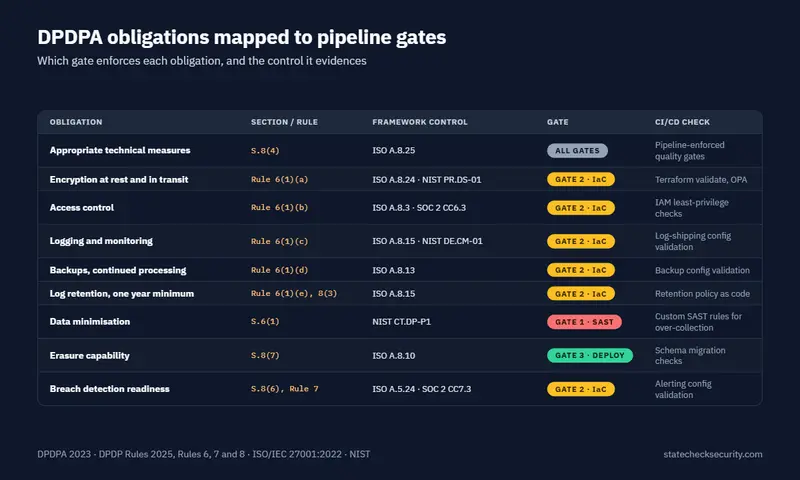
The following table maps each DPDPA obligation to established framework controls and the CI/CD tooling that implements them.
| DPDPA Obligation | Section/Rule | Framework Control | CI/CD Implementation |
|---|---|---|---|
| Appropriate technical measures | S.8(4) | ISO A.8.25 (Secure development lifecycle) | Pipeline-enforced quality gates |
| Encryption at rest and in transit | Rule 6(1)(a) | ISO A.8.24 (Use of cryptography), NIST PR.DS-01 | IaC policy checks (terraform validate, OPA) |
| Access control measures | Rule 6(1)(b) | ISO A.8.3 (Information access restriction), SOC 2 CC6.3 | IAM policy validation, least-privilege checks |
| Logging and monitoring | Rule 6(1)(c) | ISO A.8.15 (Logging), NIST DE.CM-01 | Config validation for log shipping |
| Data backup measures | Rule 6(1)(d) | ISO A.8.13 (Information backup) | Backup config validation in IaC |
| Log retention (1 year minimum) | Rule 6(1)(e), Rule 8(3) | ISO A.8.15 (Logging) | Retention policy as code |
| Data minimisation | S.6(1) | NIST Privacy CT.DP-P1 | Custom SAST rules for over-collection |
| Erasure capability | S.8(7) | ISO A.8.10 (Information deletion) | Schema migration checks |
| Breach detection readiness | S.8(6), Rule 7 | ISO A.5.24 (Incident management), SOC 2 CC7.3 | Alerting config validation |
| Secure coding | S.8(5) | ISO A.8.28 (Secure coding), SOC 2 CC6.1 | SAST, dependency scanning, secrets detection |
| Algorithmic risk (SDF only) | Rule 13(3) | NIST GV.PO-P1 | ML model fairness scanning |
Threat Model: STRIDE and LINDDUN in the Pipeline Context
Two privacy-relevant threats are particularly suited to CI/CD detection:
- STRIDE -- Information Disclosure: SAST rules catch hardcoded PII, credentials, and personal data in log statements before they reach production. This directly prevents the "accidental disclosure" component of a "personal data breach" under Section 2(u).
- LINDDUN -- Linkability and Identifiability: Data flow analysis in the pipeline can detect when personal data from separate processing purposes is being correlated without authorisation, or when test data contains real identifiable information.
Implementation Guide: Privacy-Aware CI/CD Pipeline
What Does DPDPA Require for Your CI/CD Pipeline?
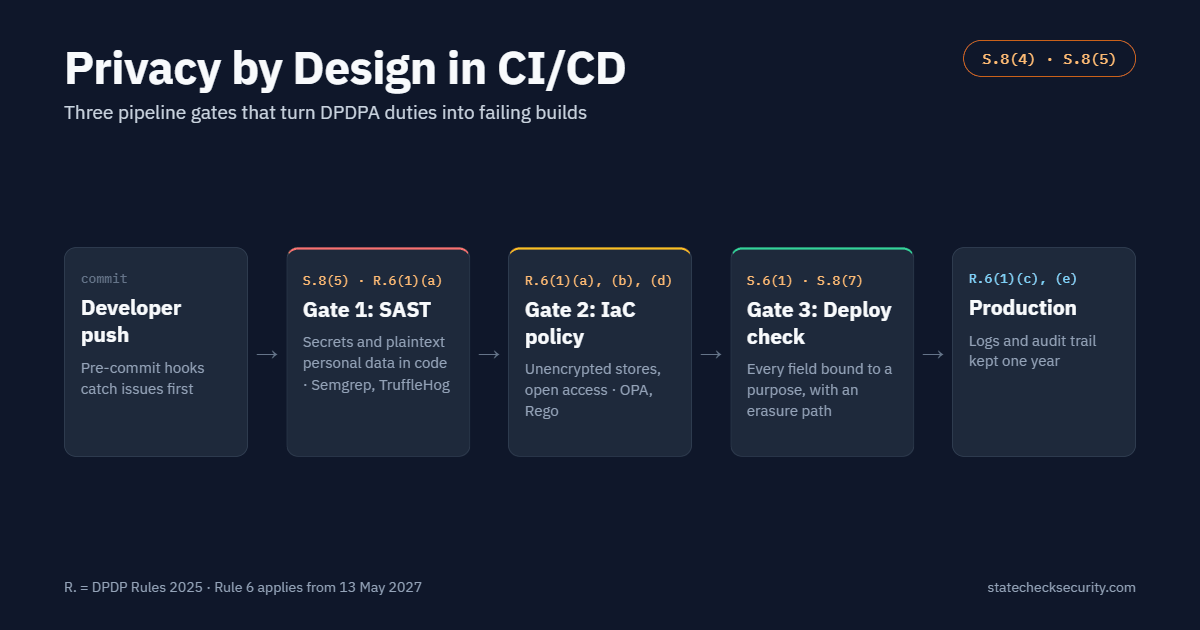
The three-gate architecture below maps to the Rule 6(1) enumeration of minimum security safeguards. Each gate is independently blockable — a failure at Gate 1 prevents progression to Gate 2, and so on. Here is the ordered sequence for setting up the complete pipeline:
- Configure pre-commit hooks with the PII detection patterns (see Gate 1 below) — catches violations before they enter the CI system at all.
- Add the Gate 1 SAST workflow file (
.github/workflows/dpdpa-privacy-checks.yml) and the custom Semgrep rules (.semgrep/dpdpa-rules.yml) to your repository. - Add the Gate 2 OPA policy files (
policies/dpdpa/encryption.rego,policies/dpdpa/retention.rego) and wire the IaC validation job as a dependency of Gate 1 (needs: sast-privacy-scan). - Create the supporting Python scripts (
check_erasure_support.py,check_purpose_bindings.py,validate_retention.py) and the PII fields config (config/pii-fields.yaml). - Add the Gate 3 deployment job (
privacy-deployment-gate) gated onneeds: iac-policy-checkandif: github.ref == 'refs/heads/main'. - Run all three gates in audit mode on the existing codebase first — generate a baseline violation report, triage by severity, and clear the backlog before switching to blocking mode.
Architecture Overview
The pipeline architecture adds three privacy-specific gate types to your existing DevSecOps flow:
flowchart LR
    A[Developer Push] --> B[Pre-Commit Hooks]
    B --> C[CI Pipeline Triggered]
    C --> D{Gate 1:<br/>SAST + Secrets}
    D -->|Pass| E{Gate 2:<br/>IaC Policy Check}
    D -->|Fail| F[Block Merge<br/>+ Report Finding]
    E -->|Pass| G{Gate 3:<br/>Privacy Deployment Gate}
    E -->|Fail| F
    G -->|Pass| H[Deploy to Staging]
    G -->|Fail| F
    H --> I[Post-Deploy Validation]
    I --> J[Production Deploy]

    style D fill:#f9d6d6,stroke:#d44
    style E fill:#fef3cd,stroke:#d4a
    style G fill:#d4edda,stroke:#28a745
Alt Text: Flowchart showing a CI/CD pipeline with three privacy-specific gates -- SAST and secrets scanning (red), infrastructure-as-code policy checks (yellow), and privacy deployment gates (green) -- each capable of blocking a merge on failure.
Gate 1: SAST and Secrets Scanning for Personal Data Exposure
This gate catches the most common source of DPDPA-relevant vulnerabilities: personal data leaking through code patterns.
What it checks (mapped to DPDPA obligations):
| Check | DPDPA Obligation | Example Violation |
|---|---|---|
| PII in log statements | S.8(5), Rule 6(1)(a) (masking) | logger.info(f"User email: {user.email}") |
| Hardcoded personal data | S.8(5) | test_aadhaar = "1234-5678-9012" |
| Secrets in source | S.8(5), Rule 6(1)(b) | DB_PASSWORD = "prod_secret_123" |
| Over-collection patterns | S.6(1) | API endpoint requesting fields beyond stated purpose |
| Unencrypted PII storage | Rule 6(1)(a) | Personal data stored in plaintext columns |
GitHub Actions configuration:
# .github/workflows/dpdpa-privacy-checks.yml
name: DPDPA Privacy Compliance Checks

on:
  pull_request:
    branches: [main, develop]
  push:
    branches: [main]

jobs:
  sast-privacy-scan:
    name: "Gate 1: SAST + PII Detection"
    runs-on: ubuntu-latest
    steps:
      - uses: actions/checkout@v4

      - name: Run Semgrep with DPDPA custom rules
        uses: returntocorp/semgrep-action@v1
        with:
          config: >-
            p/secrets
            p/owasp-top-ten
            .semgrep/dpdpa-rules.yml
        env:
          SEMGREP_APP_TOKEN: ${{ secrets.SEMGREP_APP_TOKEN }}

      - name: Detect PII in log statements
        run: |
          # Custom grep-based check for common PII logging patterns
          # Flags: aadhaar, PAN, email, phone in log/print statements
          VIOLATIONS=$(grep -rn \
            -e 'log.*\(.*aadhaar\|aadhar\|pan_number\|email.*@\)' \
            -e 'print.*\(.*aadhaar\|aadhar\|pan_number\)' \
            -e 'logger\.\(info\|debug\|warn\).*\(.*email\|phone\|mobile\)' \
            --include="*.py" --include="*.js" --include="*.ts" \
            --include="*.java" --include="*.go" \
            src/ || true)
          if [ -n "$VIOLATIONS" ]; then
            echo "::error::DPDPA Gate 1 FAILED: PII detected in log statements"
            echo "$VIOLATIONS"
            echo "Violation: Section 8(5) - reasonable security safeguards"
            echo "Rule 6(1)(a): secure personal data by masking or obfuscation; keep it out of logs"
            exit 1
          fi

      - name: Scan for hardcoded test data with real PII patterns
        run: |
          # Check for Aadhaar number patterns (XXXX-XXXX-XXXX)
          # Check for PAN patterns (AAAAA0000A)
          AADHAAR_HITS=$(grep -rn \
            -E '[0-9]{4}[\s-][0-9]{4}[\s-][0-9]{4}' \
            --include="*.py" --include="*.js" --include="*.ts" \
            --include="*.json" --include="*.yaml" --include="*.yml" \
            src/ tests/ fixtures/ || true)
          PAN_HITS=$(grep -rn \
            -E '[A-Z]{5}[0-9]{4}[A-Z]{1}' \
            --include="*.py" --include="*.js" --include="*.ts" \
            --include="*.json" --include="*.yaml" --include="*.yml" \
            src/ tests/ fixtures/ || true)
          if [ -n "$AADHAAR_HITS" ] || [ -n "$PAN_HITS" ]; then
            echo "::warning::Potential real PII in test fixtures."
            echo "DPDPA Section 6(1): data must be limited to what is necessary."
            echo "Use synthetic/anonymised test data instead."
          fi

      - name: Run TruffleHog for secrets
        uses: trufflesecurity/trufflehog@main
        with:
          extra_args: --only-verified
Equivalent GitLab CI configuration:
# .gitlab-ci.yml (privacy gates section)
stages:
  - privacy-scan
  - iac-validate
  - deploy-gate
  - deploy

dpdpa-sast-scan:
  stage: privacy-scan
  image: returntocorp/semgrep:latest
  script:
    - semgrep scan --config p/secrets --config p/owasp-top-ten
      --config .semgrep/dpdpa-rules.yml
      --error --json --output semgrep-results.json src/
    - |
      # PII in log statements check
      VIOLATIONS=$(grep -rn \
        -e 'log.*aadhaar\|aadhar\|pan_number' \
        -e 'logger\.\(info\|debug\|warn\).*email\|phone' \
        --include="*.py" --include="*.js" --include="*.go" \
        src/ || true)
      if [ -n "$VIOLATIONS" ]; then
        echo "DPDPA Gate 1 FAILED: PII in log statements"
        echo "Ref: Section 8(5), Rule 6(1)(a)"
        exit 1
      fi
  artifacts:
    reports:
      sast: semgrep-results.json
  rules:
    - if: '$CI_PIPELINE_SOURCE == "merge_request_event"'
    - if: '$CI_COMMIT_BRANCH == "main"'
Custom Semgrep rules for DPDPA-specific patterns:
# .semgrep/dpdpa-rules.yml
rules:
  - id: dpdpa-pii-in-logs
    message: >
      Logging personal data undermines the DPDPA Section 8(5) safeguards
      duty; Rule 6(1)(a) lists masking and obfuscation. PII must not appear in application logs.
      Use a structured logger with PII field redaction.
    severity: ERROR
    languages: [python]
    patterns:
      - pattern-either:
          - pattern: logging.$LEVEL(..., $EXPR, ...)
          - pattern: logger.$LEVEL(..., $EXPR, ...)
      - metavariable-regex:
          metavariable: $EXPR
          regex: .*(email|phone|aadhaar|pan_number|mobile|address).*

  - id: dpdpa-unencrypted-pii-storage
    message: >
      Storing personal data without encryption, masking or
      tokenisation falls short of Rule 6(1)(a). Use field-level encryption or ensure
      the storage backend has encryption at rest enabled.
    severity: WARNING
    languages: [python]
    pattern: |
      $MODEL.$FIELD = models.CharField(...)
    metavariable-regex:
      metavariable: $FIELD
      regex: (aadhaar|pan|email|phone|address|dob|date_of_birth)

  - id: dpdpa-excessive-data-collection
    message: >
      API endpoint collects more fields than may be necessary
      for the stated purpose. Review against DPDPA Section 6(1)
      data minimisation requirement.
    severity: WARNING
    languages: [python]
    pattern: |
      class $SERIALIZER(serializers.Serializer):
          ...
          class Meta:
              fields = '__all__'
Gate 2: Infrastructure-as-Code Policy Validation
This gate validates that your infrastructure configuration meets the technical requirements specified in Rule 6(1).
# .github/workflows/dpdpa-privacy-checks.yml (continued)
  iac-policy-check:
    name: "Gate 2: IaC DPDPA Policy Validation"
    runs-on: ubuntu-latest
    needs: sast-privacy-scan
    steps:
      - uses: actions/checkout@v4

      - name: Install OPA
        run: |
          curl -L -o opa https://openpolicyagent.org/downloads/latest/opa_linux_amd64_static
          chmod +x opa && sudo mv opa /usr/local/bin/

      - name: Validate Terraform plans against DPDPA policies
        run: |
          cd infrastructure/
          terraform init -backend=false
          terraform plan -out=tfplan.binary
          terraform show -json tfplan.binary > tfplan.json
          opa eval --data policies/dpdpa/ --input tfplan.json \
            "data.dpdpa.deny" --format pretty

      - name: Check encryption at rest (Rule 6(1)(a))
        run: |
          # Verify all S3 buckets have encryption enabled
          # Verify all RDS instances have storage encryption
          # Verify all EBS volumes are encrypted
          opa eval --data policies/dpdpa/encryption.rego \
            --input tfplan.json \
            "data.dpdpa.encryption.violations" --format pretty
          VIOLATIONS=$(opa eval --data policies/dpdpa/encryption.rego \
            --input tfplan.json \
            "data.dpdpa.encryption.violations" --format raw)
          if [ "$VIOLATIONS" != "[]" ]; then
            echo "::error::DPDPA Gate 2 FAILED: Unencrypted storage detected"
            echo "Rule 6(1)(a) lists encryption as a data security measure"
            exit 1
          fi

      - name: Validate log retention >= 1 year (Rule 8(3))
        run: |
          # Check CloudWatch log group retention is >= 365 days
          opa eval --data policies/dpdpa/retention.rego \
            --input tfplan.json \
            "data.dpdpa.retention.violations" --format pretty
Example OPA policy for DPDPA encryption requirements:
# policies/dpdpa/encryption.rego
# Enforces Rule 6(1)(a): encryption of personal data

package dpdpa.encryption

# Deny S3 buckets without server-side encryption
violations[msg] {
    resource := input.resource_changes[_]
    resource.type == "aws_s3_bucket"
    not has_encryption(resource)
    msg := sprintf(
        "S3 bucket '%s' lacks encryption. Rule 6(1)(a) lists "
        "encryption among its data security measures. [%s]",
        [resource.name, resource.address]
    )
}

# Deny RDS instances without storage encryption
violations[msg] {
    resource := input.resource_changes[_]
    resource.type == "aws_db_instance"
    resource.change.after.storage_encrypted != true
    msg := sprintf(
        "RDS instance '%s' has storage_encrypted=false. "
        "Rule 6(1)(a) violation. [%s]",
        [resource.name, resource.address]
    )
}

# Deny unencrypted EBS volumes
violations[msg] {
    resource := input.resource_changes[_]
    resource.type == "aws_ebs_volume"
    resource.change.after.encrypted != true
    msg := sprintf(
        "EBS volume '%s' is unencrypted. Rule 6(1)(a). [%s]",
        [resource.name, resource.address]
    )
}

has_encryption(resource) {
    resource.change.after.server_side_encryption_configuration != null
}
Gate 3: Privacy Deployment Gate
The final gate runs before production deployment and performs higher-level checks that require application context.
# .github/workflows/dpdpa-privacy-checks.yml (continued)
  privacy-deployment-gate:
    name: "Gate 3: Privacy Deployment Validation"
    runs-on: ubuntu-latest
    needs: iac-policy-check
    if: github.ref == 'refs/heads/main'
    steps:
      - uses: actions/checkout@v4

      - name: Verify erasure capability exists (Section 8(7))
        run: |
          # Check that all models storing personal data have
          # a corresponding erasure/anonymisation method
          python scripts/check_erasure_support.py \
            --models-dir src/models/ \
            --pii-fields-config config/pii-fields.yaml
          # Exit code 1 if any PII model lacks erasure support

      - name: Validate consent purpose bindings (Section 6(1))
        run: |
          # Verify API endpoints that collect personal data
          # have corresponding consent purpose declarations
          python scripts/check_purpose_bindings.py \
            --api-spec openapi.yaml \
            --consent-config config/consent-purposes.yaml

      - name: Check data retention configuration (Rule 8(1))
        run: |
          # Verify erasure periods match the Third Schedule (listed platform classes only)
          python scripts/validate_retention.py \
            --retention-config config/data-retention.yaml \
            --dpdpa-schedule config/dpdpa-third-schedule.yaml

      - name: Generate DPDPA compliance report
        run: |
          python scripts/generate_compliance_report.py \
            --sast-results sast-results.json \
            --iac-results iac-results.json \
            --output compliance-report.json
        # This report becomes audit evidence for Section 8(4)
        # and Rule 6(1)(g) "appropriate technical and organisational measures"

      - name: Upload compliance report as artifact
        uses: actions/upload-artifact@v4
        with:
          name: dpdpa-compliance-report
          path: compliance-report.json
          retention-days: 365  # matches the 1-year log floor in Rules 6(1)(e) and 8(3)
Supporting Script: PII Erasure Capability Check
#!/usr/bin/env python3
"""
check_erasure_support.py
Validates that every model containing PII fields has a corresponding
erasure method, satisfying DPDPA Section 8(7) erasure obligations.

Usage: python check_erasure_support.py \
         --models-dir src/models/ \
         --pii-fields-config config/pii-fields.yaml
"""
import argparse
import ast
import sys
from pathlib import Path

import yaml


def load_pii_fields(config_path: str) -> set:
    """Load the set of field names classified as PII."""
    with open(config_path) as f:
        config = yaml.safe_load(f)
    return set(config.get("pii_field_names", []))


def check_model_file(file_path: Path, pii_fields: set) -> list:
    """Parse a Python model file and check for erasure support."""
    violations = []
    source = file_path.read_text()
    tree = ast.parse(source, filename=str(file_path))

    for node in ast.walk(tree):
        if not isinstance(node, ast.ClassDef):
            continue

        # Find fields that match PII field names
        model_pii_fields = []
        has_erasure_method = False

        for item in node.body:
            # Check for PII field assignments
            if isinstance(item, ast.Assign):
                for target in item.targets:
                    if isinstance(target, ast.Name):
                        if target.id in pii_fields:
                            model_pii_fields.append(target.id)

            # Check for erasure/anonymise method
            if isinstance(item, (ast.FunctionDef, ast.AsyncFunctionDef)):
                if item.name in ("erase", "anonymise", "anonymize",
                                 "delete_personal_data", "gdpr_erase",
                                 "dpdpa_erase"):
                    has_erasure_method = True

        if model_pii_fields and not has_erasure_method:
            violations.append({
                "file": str(file_path),
                "model": node.name,
                "pii_fields": model_pii_fields,
                "violation": (
                    f"Model '{node.name}' contains PII fields "
                    f"{model_pii_fields} but has no erasure method. "
                    f"DPDPA Section 8(7) requires erasure capability."
                ),
            })

    return violations


def main():
    parser = argparse.ArgumentParser()
    parser.add_argument("--models-dir", required=True)
    parser.add_argument("--pii-fields-config", required=True)
    args = parser.parse_args()

    pii_fields = load_pii_fields(args.pii_fields_config)
    models_dir = Path(args.models_dir)
    all_violations = []

    for py_file in models_dir.rglob("*.py"):
        violations = check_model_file(py_file, pii_fields)
        all_violations.extend(violations)

    if all_violations:
        print(f"DPDPA GATE 3 FAILED: {len(all_violations)} model(s) "
              f"lack erasure support")
        for v in all_violations:
            print(f"  - {v['violation']}")
        sys.exit(1)
    else:
        print("DPDPA Gate 3 PASSED: All PII models have erasure methods")
        sys.exit(0)


if __name__ == "__main__":
    main()
PII Fields Configuration
# config/pii-fields.yaml
# Fields classified as personal data under DPDPA Section 2(t)
# "personal data means any data about an individual who is
#  identifiable by or in relation to such data"

pii_field_names:
  # Direct identifiers
  - aadhaar
  - aadhaar_number
  - pan
  - pan_number
  - passport_number
  - voter_id

  # Contact information
  - email
  - email_address
  - phone
  - phone_number
  - mobile
  - mobile_number
  - address
  - postal_code
  - pincode

  # Biometric, health and financial (DPDPA has no separate 'sensitive' category)
  - date_of_birth
  - dob
  - gender
  - biometric_data
  - health_data
  - financial_data

  # Behavioural (relevant for Section 9 -- children)
  - location_data
  - browsing_history
  - device_fingerprint
  - ip_address
Pipeline Integration: End-to-End Flow
The following diagram shows how these three gates integrate with a standard deployment workflow.
sequenceDiagram
    participant Dev as Developer
    participant PR as Pull Request
    participant G1 as Gate 1: SAST
    participant G2 as Gate 2: IaC
    participant G3 as Gate 3: Deploy
    participant Prod as Production
    participant Audit as Audit Trail

    Dev->>PR: Push code changes
    PR->>G1: Trigger SAST + secrets scan
    G1->>G1: Semgrep custom rules (PII in logs)
    G1->>G1: TruffleHog (secrets detection)
    G1->>G1: PII pattern matching (Aadhaar, PAN)

    alt Gate 1 fails
        G1->>PR: Block merge + report violations
        G1->>Audit: Log finding (S.8(5) non-compliance)
    else Gate 1 passes
        G1->>G2: Trigger IaC policy check
    end

    G2->>G2: OPA/Rego: encryption at rest check
    G2->>G2: OPA/Rego: log retention >= 365 days
    G2->>G2: OPA/Rego: IAM least-privilege check

    alt Gate 2 fails
        G2->>PR: Block merge + report violations
        G2->>Audit: Log finding (Rule 6(1) non-compliance)
    else Gate 2 passes
        G2->>G3: Trigger deployment gate
    end

    G3->>G3: Erasure capability check (S.8(7))
    G3->>G3: Purpose binding validation (S.6(1))
    G3->>G3: Retention config check (Rule 8(1))

    alt Gate 3 fails
        G3->>PR: Block deploy + report violations
    else Gate 3 passes
        G3->>Prod: Deploy to production
        G3->>Audit: Generate compliance report
    end

    Audit->>Audit: Retain reports with logs for >= 1 year (Rules 6(1)(e), 8(3))
Alt Text: Sequence diagram showing the end-to-end flow of a DPDPA privacy-aware CI/CD pipeline with three gates -- SAST scanning, infrastructure-as-code policy validation, and deployment-time privacy checks -- each generating audit trail entries retained for one year per Rule 8(3).
GitHub Actions DPDPA Gates (YAML)
FAQ: DPDPA Privacy by Design in CI/CD
Does DPDPA require privacy by design?
Yes — Section 8(4) requires Data Fiduciaries to implement "appropriate technical and organisational measures to ensure effective observance of the provisions of this Act." This is the statutory basis for privacy by design: the Act mandates technical enforcement, not merely policy documentation. A CI/CD pipeline with automated compliance gates is the engineering expression of that mandate.
What CI/CD gates are required for DPDPA compliance?
The DPDPA does not prescribe specific pipeline tooling, but Rule 6(1) enumerates what "reasonable security safeguards" must achieve: encryption of personal data (Rule 6(1)(a)), access control (Rule 6(1)(b)), logging and monitoring (Rule 6(1)(c)), backup and availability (Rule 6(1)(d)), and one-year retention of logs and personal data (Rule 6(1)(e)). The three-gate architecture in this guide — SAST, IaC policy validation, and deployment checks — maps directly to this enumeration.
How do you detect PII in code at commit time?
The most effective approach combines three layers: (1) pre-commit hooks using grep patterns for Aadhaar (XXXX-XXXX-XXXX format), PAN (AAAAA0000A format), and common field names; (2) Semgrep custom rules that do semantic analysis — detecting PII in log calls even when the field name is an indirect variable reference; and (3) TruffleHog for credential and secrets detection. The PII fields config (config/pii-fields.yaml) shown in this guide defines the canonical list of field names classified as personal data under DPDPA Section 2(t).
What is Section 8(4) of DPDPA?
Section 8(4) is the DPDPA's privacy by design obligation. It states: "A Data Fiduciary shall implement appropriate technical and organisational measures to ensure effective observance of the provisions of this Act and the rules made thereunder." This provision, read together with Rule 6(1)'s enumeration of minimum security safeguards, creates a legally enforceable requirement for technical controls — not just policies. The Data Protection Board can assess penalties under the Schedule for failure to implement appropriate technical measures.
How does DPDPA privacy-by-design compare to GDPR Article 25?
| Dimension | DPDPA Section 8(4) | GDPR Article 25 |
|---|---|---|
| Explicit "privacy by design" language | No — uses "appropriate technical and organisational measures" | Yes — explicitly names "data protection by design and by default" |
| Scope | All Data Fiduciaries | All Data Controllers |
| Default protections mandate | Implied via S.8(5) and Rule 6(1) | Explicit: "only personal data which are necessary for each specific purpose" by default |
| Certification mechanism | Not yet specified | Article 25(3) allows approved certification mechanisms |
| Enforcement anchor | S.8(4) + Schedule penalties | Article 83(4): up to €10M or 2% global turnover |
| Children's data | Section 9 (under-18; verifiable parental consent per Rule 10, with class- and purpose-based exemptions in Rule 12 and the Fourth Schedule) | Article 8 (varies by member state, typically 13-16) |
Myth: Privacy-by-design compliance requires a separate review gate that slows down deployments.
This is a common misconception. The three gates in this guide run in parallel with — or are integrated directly into — your existing CI jobs. Gate 1 (SAST) typically adds 2-4 minutes to a pull request check that already runs SAST. Gate 2 (IaC) runs alongside terraform plan validation. Gate 3 (deployment checks) runs in the same job sequence as your existing pre-production smoke tests. The automation cost is front-loaded: writing the rules and scripts. After that, the pipeline enforces privacy by design faster than any manual review process.
Common Pitfalls
Q: Is a CI/CD privacy gate sufficient to satisfy Section 8(4)'s "appropriate technical and organisational measures"?
No single control satisfies Section 8(4) in isolation. A CI/CD pipeline with privacy gates is one layer of a defense-in-depth approach. You also need runtime controls (WAF, DLP, monitoring), organisational measures (training, incident response playbooks), and governance (DPIAs, audit schedules). The pipeline catches issues at the earliest and cheapest point in the development lifecycle -- but it is not a substitute for the rest of the stack.
Q: How do we handle false positives from PII detection rules?
Use a suppression mechanism with audit trail requirements. Every suppression should require: (1) a justification comment in code referencing the DPDPA section that makes it acceptable, (2) approval from a designated reviewer, and (3) periodic review of all suppressions. Never silently suppress findings -- that defeats the purpose of the gate and creates audit risk.
Q: Should the pipeline block merges or just warn?
For Gate 1 (secrets and hardcoded PII): block. These are clear violations with no legitimate justification. For Gate 2 (IaC policy): block for encryption and access control, warn for configuration best practices. For Gate 3 (deployment checks): block for missing erasure capability on PII models, warn for purpose binding gaps that may need product team input.
Q: What about existing code that predates these checks?
Run the gates in audit mode first. Generate a baseline report of all existing violations, prioritise them by severity (secrets and unencrypted PII first), and work through the backlog. Switch to blocking mode once the backlog is cleared. This is exactly how you would approach any SAST rollout -- the DPDPA context does not change the adoption pattern.
Q: How does this apply to Data Processors?
Under Section 8(1), the Data Fiduciary is responsible for compliance "in respect of any processing undertaken by it or on its behalf by a Data Processor." If you are a SaaS company acting as a Data Processor, Rule 6(1)(f) requires your Data Fiduciary client to make "appropriate provision in the contract" with you for taking reasonable security safeguards. These pipeline checks give those clients auditable evidence that you meet the safeguards the contract requires.
Q: What is the penalty exposure for not implementing technical measures?
The Schedule to the DPDPA specifies that breach of Section 8(5) (reasonable security safeguards) may attract a penalty extending to two hundred and fifty crore rupees (approximately USD 26 million at about ₹95/USD, October 2026). Breach of "any other provision" (which would include Section 8(4)) may extend to fifty crore rupees. These are maximum amounts; the Board considers factors including the nature of the breach, mitigation actions taken, and proportionality (Section 33(2)). The existence of automated pipeline controls is direct evidence of mitigation action under Section 33(2)(e).
Next Steps
Ready to embed DPDPA compliance into your deployment pipeline? StateCheck Security builds custom privacy-aware CI/CD gates tailored to your tech stack, data architecture, and DPDPA obligation profile. We do not just hand you YAML files -- we work with your engineering team to implement, tune, and maintain the gates as your codebase and the regulatory landscape evolve.
Request a DPDPA Compliance Audit
Related Articles
- The DPDPA to ISO 27001 Mapping Guide: Leveraging Annex A for Privacy Compliance -- Maps the DPDPA obligations referenced in this article to ISO 27001:2022 Annex A controls. Use it to understand which framework controls your pipeline gates are enforcing.
- SOC 2 Privacy Criteria vs. DPDPA: Bridging the Gap for Indian SaaS Companies -- If your SaaS company already holds SOC 2, this companion piece shows which Trust Services Criteria overlap with the DPDPA obligations automated by these pipeline gates.
- Threat Modeling for DPDPA: Adapting LINDDUN and STRIDE for Privacy -- Deep dive into the STRIDE and LINDDUN threat categories referenced in the framework mapping table above.
- The DPDPA Breach Notification: Automating SIEM Alerts to Legal Workflows -- What happens when your pipeline gates miss something and a breach occurs. The incident response automation companion to this prevention-focused article.