
Zero Trust Architecture as a DPDPA Compliance Enabler
Key Takeaways
- DPDPA Rule 6(1)(b) requires "appropriate measures to control access to the computer resources" that process personal data. The Rules do not use the words "least privilege" or "Zero Trust", but Zero Trust Architecture is the most direct engineering pattern for meeting that duty.
- Section 8(5) requires reasonable security safeguards to prevent personal data breach; the penalty for breaching it may extend to ₹250 crore (the Schedule, item 1).
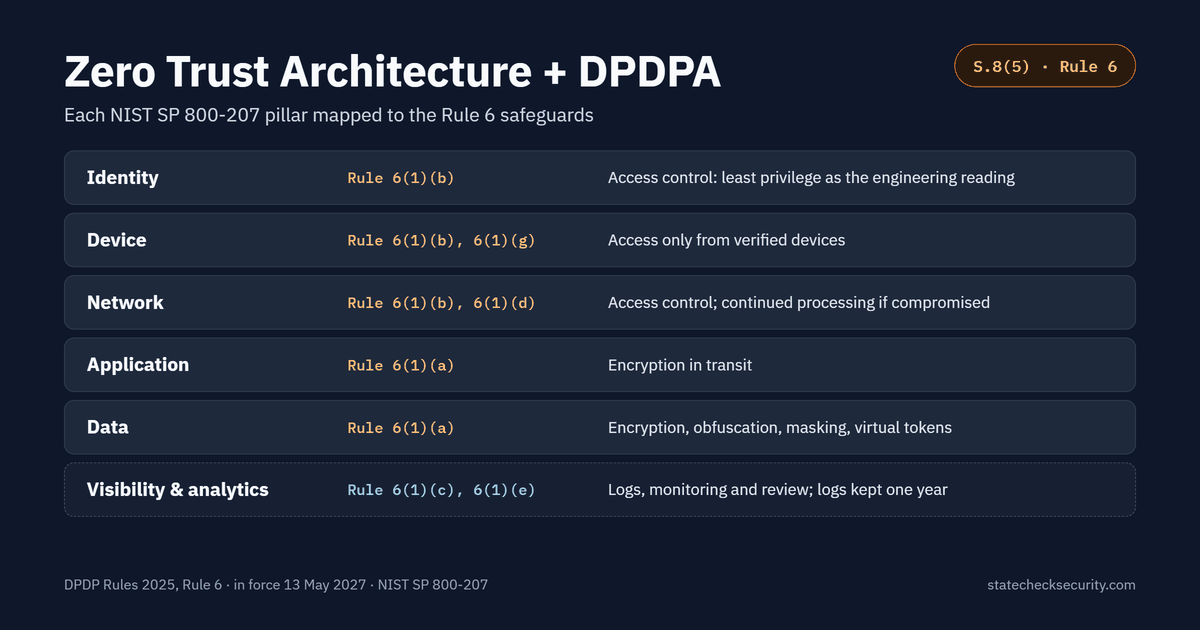
- Zero Trust's five pillars (Identity, Device, Network, Application, Data) each map to a specific Rule 6(1) safeguard.
- DPDPA breach intimation (Rule 7) runs on two clocks: affected Data Principals and the Board are told "without delay", then a detailed report goes to the Board within 72 hours (extendable on written request).
- A six-week roadmap can take an organisation from a flat perimeter network to a defensible zero trust DPDPA compliance posture.
- Section 16 cross-border transfers are permissive by default (negative-list model) — not an approved-country allowlist.
Key terms: Data Fiduciary — the entity that determines the purpose and means of processing personal data (equivalent to GDPR Controller). Data Principal — the natural person whose data is processed (equivalent to Data Subject). Significant Data Fiduciary (SDF) — a Data Fiduciary designated under Section 10 with elevated obligations including DPIAs, annual audits, and a Data Protection Officer. Reasonable security safeguards — the Section 8(5) duty; Rule 6(1) sets their minimum content. TOMs — Technical and Organisational Measures, required by Section 8(4) and, for security safeguards specifically, by Rule 6(1)(g).
In this article:
- What does DPDPA require for security controls?
- Zero Trust Architecture: Statutory Obligations Mapped to Five Pillars
- Identity Pillar: Operationalising Rule 6(1)(b)
- Device Pillar: CIA Assurance for Processing Systems
- Network Pillar: Micro-Segmentation for Personal Data Isolation
- Data Pillar: Encryption and Pseudonymisation
- Visibility Pillar: Continuous Monitoring Under Rule 6(1)(c)
- How do you build a Zero Trust DPDPA compliance roadmap in six weeks?
- Frequently Asked Questions
- Downloadable Resources
Indian enterprises approaching DPDPA compliance often start with consent flows and data principal rights — the visible, user-facing obligations. But the obligation with the highest penalty exposure sits quietly in Section 8(5): Data Fiduciaries must protect personal data by taking reasonable security safeguards to prevent personal data breach, with a penalty that may extend to ₹250 crore.
Rule 6 of the DPDP Rules 2025 sets the minimum content of those safeguards. Read sub-rule (1)(b): "appropriate measures to control access to the computer resources" used by the Data Fiduciary or its Data Processor. The Rule does not say "least privilege" or "Zero Trust". Least privilege is how security engineers make access control "appropriate", and Zero Trust Architecture is the pattern that enforces it on every request.
This article maps NIST SP 800-207's five ZTA pillars against DPDPA Section 8(5) and Rule 6 to show how zero trust DPDPA compliance is built from the statutory text up — with OPA Rego policies you can deploy today and a six-week implementation roadmap.
What does DPDPA require for security controls?
Before architecting controls, establish what the law says — precisely.
Section 8(5) of the DPDPA 2023 states:
"A Data Fiduciary shall protect personal data in its possession or under its control, including in respect of any processing undertaken by it or on its behalf by a Data Processor, by taking reasonable security safeguards to prevent personal data breach."
Section 8(4) separately requires "appropriate technical and organisational measures to ensure effective observance of the provisions of this Act and the rules made thereunder".
The operative minimums are in Rule 6(1) of the DPDP Rules 2025, which lists what the reasonable security safeguards "shall include, at the minimum" (paraphrased here; the Rule text is quoted where it matters below):
| Sub-rule | Safeguard (paraphrased) | ZTA Pillar Served |
|---|---|---|
| 6(1)(a) | Data security measures such as encryption, obfuscation, masking or virtual tokens | Data, Application |
| 6(1)(b) | Measures to control access to the computer resources used by the Data Fiduciary or Data Processor | Identity, Device, Network |
| 6(1)(c) | Visibility on access through logs, monitoring and review, to detect, investigate and remediate unauthorised access | Visibility |
| 6(1)(d) | Continued processing if confidentiality, integrity or availability is compromised (e.g. data backups) | Network, Data |
| 6(1)(e) | Retain those logs and personal data for one year, unless another law requires otherwise | Visibility |
| 6(1)(f) | Security-safeguard clauses in Data Processor contracts | All pillars (supply chain) |
| 6(1)(g) | Technical and organisational measures to ensure effective observance of the safeguards | All pillars |
Rule 6 applies from 13 May 2027. Rule 6 sets no separate security standard for Significant Data Fiduciaries (SDFs). If you are notified as an SDF under Section 10, Rule 13 adds an annual Data Protection Impact Assessment and audit, whose significant observations are furnished to the Board, and Rule 13(3) adds due diligence on algorithmic software.
One critical correction on breaches: Rule 7 has two clocks. Rule 7(1) requires intimation to each affected Data Principal "without delay", and Rule 7(2)(a) requires an initial intimation to the Board "without delay". Rule 7(2)(b) then requires a detailed report to the Board "within seventy-two hours of becoming aware of the breach, or within such longer period as the Board may allow on a request made in writing". The DPDPA phrase is "without delay"; do not import GDPR Article 33 wording.
For the full DPDPA-to-ISO 27001:2022 obligation mapping (all 40+ Annex A identifiers), see DPDPA to ISO 27001:2022 Mapping. For the SOC 2 Trust Services Criteria crosswalk, see SOC 2 vs DPDPA.
How do Zero Trust's five pillars map to DPDPA Rule 6?
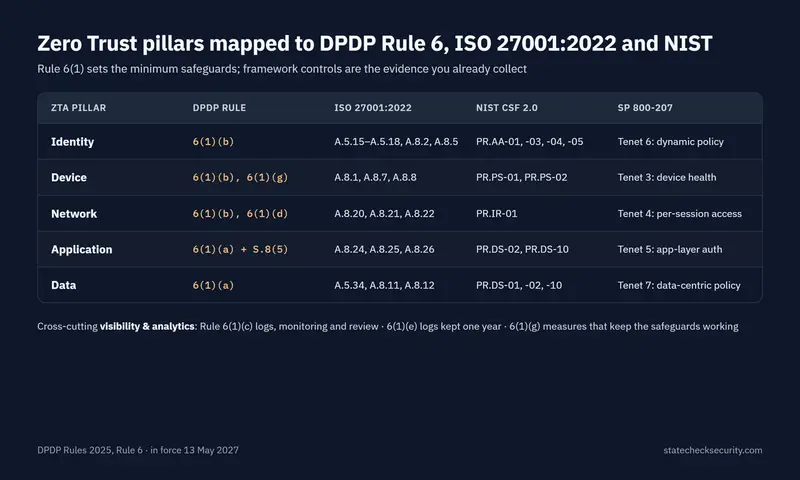
The zero trust DPDPA compliance mapping every practitioner needs — ZTA pillar, statutory obligation, and control framework reference:
| ZTA Pillar | DPDPA Obligation | ISO 27001:2022 | NIST CSF 2.0 | NIST SP 800-207 Tenet |
|---|---|---|---|---|
| Identity | Rule 6(1)(b) — access control (least privilege) | A.5.15, A.5.16, A.5.17, A.5.18, A.8.2, A.8.5 | PR.AA-01, PR.AA-03, PR.AA-04, PR.AA-05 | Tenet 6 — dynamic policy |
| Device | Rule 6(1)(b), 6(1)(g) — access only from verified devices | A.8.1, A.8.7, A.8.8 | PR.PS-01, PR.PS-02 | Tenet 3 — device health |
| Network | Rule 6(1)(b), 6(1)(d) — access control; continued processing | A.8.20, A.8.21, A.8.22 | PR.IR-01 | Tenet 4 — per-session access |
| Application/Workload | Rule 6(1)(a), S.8(5) — encryption | A.8.24, A.8.25, A.8.26 | PR.DS-02, PR.DS-10 | Tenet 5 — app-layer auth |
| Data | Rule 6(1)(a) — encryption, masking, virtual tokens | A.5.34, A.8.11, A.8.12 | PR.DS-01, PR.DS-02, PR.DS-10 | Tenet 7 — data-centric policy |
Cross-cutting: Visibility and Analytics maps to Rule 6(1)(c) (logs, monitoring and review), Rule 6(1)(e) (one-year log retention) and Rule 6(1)(g) (measures to ensure the safeguards work).
Identity Pillar: Operationalising Rule 6(1)(b)
Rule 6(1)(b) requires "appropriate measures to control access to the computer resources" used by the Data Fiduciary or its Data Processor. The Rule does not name least privilege, but standing, over-broad access to systems holding personal data is hard to defend as "appropriate". Least privilege data protection is therefore the defensible reading of Rule 6(1)(b): no longer just a security recommendation your team has to argue for, but the way to evidence a safeguard whose breach can attract a penalty of up to ₹250 crore. For IAM DPDPA implementations, this statutory hook is the lever that moves over-provisioning from an engineering inconvenience to a boardroom risk.
In DPDPA readiness assessments conducted by StateCheck Security across Indian mid-market enterprises, over-privileged service accounts are the most prevalent Rule 6(1)(b) gap. Observed patterns: median time to deploy deny-by-default OPA policies on a single personal-data schema is 5–7 working days; median reduction in standing privileged sessions after rollout is 80–90%. Against a penalty exposure of up to ₹250 crore for breach of Section 8(5), the engineering cost of a six-week pilot — typically ₹40–70 lakh for a 200-to-500 engineer organisation — is a risk-adjusted ROI most security boards approve in a single meeting.
Methodology note: figures reflect StateCheck Security internal engagement observations. Use as directional benchmarks, not industry-wide statistics.
What least privilege means for personal data systems:
- Service accounts that touch a
personal_dataschema get only the permissions they use in production — not convenience roles. - Human access follows just-in-time (JIT) elevation: engineers request scoped access for a session, not persistent admin.
- Every access grant logs the requesting identity, the resource, the justification, and the duration.
OPA Rego policy (minimal):
# policies/dpdpa_least_privilege.rego
package dpdpa.iam

import future.keywords.if
import future.keywords.contains

# Rule 6(1)(b): control access to computer resources holding personal data,
# implemented on the principle of least privilege.
default allow := false

allow if {
    input.action in data.permissions[input.principal][input.resource]
}

# Deny access to personal_data scope unless explicitly granted
deny contains msg if {
    input.resource_scope == "personal_data"
    not allow
    msg := sprintf(
        "Access denied: %v lacks %v permission on %v (DPDPA Rule 6(1)(b))",
        [input.principal, input.action, input.resource]
    )
}
This policy enforces a deny-by-default posture: every access to a personal-data-scoped resource requires an explicit grant in the data.permissions store. The deny message cites Rule 6(1)(b) directly, which makes compliance audit trails self-documenting.
ISO 27001:2022 controls satisfied: A.5.15 (access control), A.5.16 (identity management), A.5.17 (authentication), A.8.2 (privileged access), A.8.5 (secure authentication).
Device Pillar: CIA Assurance for Processing Systems
Rule 6(1)(b) covers access to "computer resources", and devices are where that access starts. Rule 6(1)(g) adds "appropriate technical and organisational measures to ensure effective observance of security safeguards". Under Zero Trust, this translates to continuous device health verification before any access is granted.
CISA's Zero Trust Maturity Model v2.0 defines four device-pillar maturity levels. At Advanced maturity — which a DPDPA SDF should target — devices must:
- Continuously emit telemetry to a centralised posture assessment engine.
- Fail closed: if a device's compliance state cannot be verified, it loses access to personal-data systems until posture is restored.
- Show a clean bill of health (EDR, patch level, disk encryption status) before any JIT elevation is granted.
ISO 27001:2022: A.8.1 (endpoint devices), A.8.7 (protection against malware), A.8.8 (management of technical vulnerabilities).
Network Pillar: Micro-Segmentation for Personal Data Isolation
Legacy flat networks treat the perimeter as the security boundary. Once an attacker crosses it, personal data stores are exposed. DPDPA Rule 6(1)(b) requires control of access to those computer resources, and Rule 6(1)(d) requires "reasonable measures for continued processing" if confidentiality, integrity or availability is compromised. Segmentation serves both by limiting how far a compromise spreads.
Micro-segmentation enforces Rule 6(1)(b) at the infrastructure layer:
- East-west traffic filtering: Services that process personal data are placed in dedicated network segments. Cross-segment traffic requires explicit allow rules; everything else is denied.
- Per-session authorisation: NIST SP 800-207 Tenet 4 — no implicit trust for ongoing sessions. Each request carries identity and device context; the policy engine re-evaluates on every call.
OPA network policy example:
# policies/dpdpa_network_policy.rego
package dpdpa.network

import future.keywords.if

# Default: deny all cross-segment flows to personal_data_zone
default allow_flow := false

allow_flow if {
    input.src_segment != "personal_data_zone"
    input.dst_segment != "personal_data_zone"
}

allow_flow if {
    input.dst_segment == "personal_data_zone"
    # Require: source is an approved service AND device posture is healthy
    input.src_service in data.approved_services
    input.device_posture.compliant == true
}
For cross-border data transfers, note that Section 16 of DPDPA operates on a negative-list model: transfers are permitted by default; the Central Government restricts specific countries by notification. Your network policies should default to transfer_allowed := true and block only on data.blocked_countries. A positive allowlist architecture misrepresents the law.
Data Pillar: Encryption and Pseudonymisation
Rule 6(1)(a) requires "appropriate data security measures, such as securing of personal data through encryption, obfuscation, masking or the use of virtual tokens mapped to that personal data". It names no algorithm and does not distinguish data at rest from data in transit; the choices below are engineering defaults. Tokenisation and masking cover what GDPR calls pseudonymisation.
Both controls are data-centric — they protect personal data regardless of which network path it travels or which identity accesses it. This is Zero Trust's data pillar in statutory form.
Implementation guidance:
- At rest: AES-256-GCM for database column encryption. For PostgreSQL users,
pgcryptowith a proper KMS-managed key hierarchy. The encryption key must be separate from the data store. - In transit: TLS 1.3 minimum. Certificate pinning for internal service-to-service calls in the personal data segment.
- Pseudonymisation: Replace direct identifiers (name, email, phone) with a reversible token in analytics pipelines. Store the token-to-identity mapping in a separate, access-controlled vault.
For deeper implementation detail on encryption primitives and key management, see DPDPA Encryption Requirements.
ISO 27001:2022: A.5.34 (privacy), A.8.11 (data masking), A.8.12 (data leakage prevention).
NIST CSF 2.0: PR.DS-01, PR.DS-02, PR.DS-10.
Visibility Pillar: Continuous Monitoring Under Rule 6(1)(c)
Rule 6(1)(c) requires "visibility on the accessing of such personal data, through appropriate logs, monitoring and review, for enabling detection of unauthorised access, its investigation and remediation to prevent recurrence". Rule 6(1)(e) requires those logs to be retained for one year. Together, these two sub-rules are the DPDPA's continuous monitoring obligation.
Under ZTA, visibility is not a bolted-on SIEM — it's a first-class architectural component that every pillar feeds into.
What the audit logger must capture for Rule 6(1)(c) compliance:
# src/zt_audit_logger.py
import json
import hashlib
from datetime import datetime, timezone

def log_personal_data_access(
    principal: str,
    resource: str,
    action: str,
    outcome: str,       # "allow" | "deny"
    device_id: str,
    session_id: str,
) -> dict:
    """
    Emit a structured audit event for Rule 6(1)(c) compliance.
    Captures: who accessed what, from which device, in which session,
    and whether access was granted or denied.
    """
    event = {
        "timestamp": datetime.now(timezone.utc).isoformat(),
        "principal": principal,
        "resource": resource,
        "action": action,
        "outcome": outcome,
        "device_id": device_id,
        "session_id": session_id,
        "legal_basis": "Rule 6(1)(c) — DPDP Rules 2025",
    }
    # Integrity seal — SHA-256 over canonical JSON
    canonical = json.dumps(event, sort_keys=True, ensure_ascii=False)
    event["integrity_hash"] = hashlib.sha256(canonical.encode("utf-8")).hexdigest()
    return event
Key implementation notes:
ensure_ascii=Falseis mandatory if any field contains non-ASCII characters (Hindi names, regional script identifiers). ASCII-escaping these characters causes hash divergence if you ever verify the seal against a PostgreSQL-stored canonical form.- Log retention: Rule 6(1)(e) requires security logs and personal data to be kept for one year, and Rule 8(3) requires personal data, traffic data and processing logs to be kept for at least one year from processing, then erased unless another law requires longer. Longer periods (SEBI/RBI rules often mandate 5–7 years) come from sectoral law; name that law. Do not attribute a 7-year floor to DPDPA.
- The integrity hash converts the log into a tamper-evident audit trail, supporting the "review" limb of Rule 6(1)(c) and the effective-observance duty in Rule 6(1)(g).
For automated workflows that pipe this audit trail into a SIEM and trigger Board notifications, see DPDPA Breach Notification Automation.
How do you build a Zero Trust DPDPA compliance roadmap in six weeks?
For organisations deploying zero trust architecture in India under DPDPA constraints, six weeks delivers a defensible, audit-ready posture:
- Weeks 1–2 — Foundation: Enumerate all personal data stores and processing flows. Classify each asset as personal data, pseudonymous, or non-personal. Map existing IAM role bindings to identify over-provisioned accounts and build a least-privilege remediation backlog.
- Weeks 2–3 — Identity: Deploy deny-by-default OPA policies for all personal-data APIs. Instrument JIT access with time-bound grants for human access to production databases. Enforce MFA for all privileged sessions.
- Weeks 3–4 — Network: Segment personal-data systems into a dedicated network zone. Enable per-session re-authorisation and block all unapproved cross-zone flows. Deploy device-posture checks as a prerequisite for zone access.
- Weeks 4–5 — Data: Audit encryption coverage; enforce AES-256-GCM at rest and TLS 1.3 in transit. Implement pseudonymisation for analytics pipelines — direct identifiers replaced with vault-backed tokens.
- Weeks 5–6 — Visibility: Deploy Rule 6(1)(c)-compliant audit logging at every personal-data system entry point. Wire SIEM alerting for deny events and non-compliant device access. Set log retention policy per Rules 6(1)(e) and 8(3) and applicable sectoral law.
| Week | Focus | Deliverable |
|---|---|---|
| 1–2 | Foundation | Data inventory + IAM gap report |
| 2–3 | Identity | OPA deployed + JIT access instrumented |
| 3–4 | Network | Micro-segmentation + mTLS + device posture |
| 4–5 | Data | Encryption audit + pseudonymisation pipeline |
| 5–6 | Visibility | Audit logging + SIEM + retention policy |
After the six-week sprint, schedule quarterly control-effectiveness assessments (Rule 6(1)(g)) and annual penetration testing against the ZTA boundary.
For the CI/CD integration that gates deployments on ZTA policy compliance, see Privacy by Design in CI/CD.
Frequently Asked Questions
Does DPDPA require Zero Trust Architecture?
No. Neither the Act nor the Rules name "Zero Trust" or "least privilege". Rule 6(1)(b) of the DPDP Rules 2025 requires "appropriate measures to control access to the computer resources used by such Data Fiduciary or such a Data Processor, wherever applicable", and Rule 6(1)(c) requires logs, monitoring and review of access. Zero Trust Architecture is a well-recognised way to meet those duties and to evidence them to the Board, but it is an implementation choice, not a statutory requirement.
What is DPDP Rule 6(1)(b)?
Rule 6(1)(b) is one of the minimum reasonable security safeguards that Rule 6 sets for the Section 8(5) duty. It requires "appropriate measures to control access to the computer resources" used by the Data Fiduciary or its Data Processor. It does not prescribe least privilege by name; least privilege is the engineering standard that makes access control "appropriate". For teams designing IAM DPDPA controls, it is the legal obligation that underpins every identity policy, role binding, and JIT access workflow. Rule 6 applies from 13 May 2027.
What is the penalty for failing DPDPA Section 8(5)?
Breach of the obligation to take reasonable security safeguards under Section 8(5) can attract a monetary penalty of up to ₹250 crore (approximately USD 26 million at about ₹95/USD, October 2026). Item 1 of the Schedule to the DPDPA 2023 (Section 33(1)) reads: "May extend to two hundred and fifty crore rupees." This is the highest penalty tier in the Act and applies directly to the obligation that Zero Trust Architecture addresses.
How does DPDPA breach notification differ from GDPR?
GDPR Article 33 requires notification to the supervisory authority within 72 hours of becoming aware of a breach, unless the breach is unlikely to result in a risk to individuals. DPDPA Rule 7 has no such risk threshold and runs two clocks. First, each affected Data Principal (Rule 7(1)) and the Data Protection Board (Rule 7(2)(a)) must be told "without delay". Second, a detailed report goes to the Board "within seventy-two hours of becoming aware of the breach" (Rule 7(2)(b)), or a longer period the Board allows on a written request. Rule 7 applies from 13 May 2027.
Is there a 72-hour breach notification rule under DPDPA?
Yes, for the detailed report. Under Rule 7(2)(b) of the DPDP Rules 2025, the Data Fiduciary must give the Board updated and detailed information about the breach, its causes, mitigation, remedial measures and the intimations sent to Data Principals "within seventy-two hours of becoming aware of the breach", unless the Board allows longer on a written request. Before that, Rule 7(1) and Rule 7(2)(a) require an initial intimation to each affected Data Principal and to the Board "without delay", so the 72 hours is an outer limit for the detailed report, not a grace period for the first notice. Treat "without delay" as immediate escalation.
How do DPDPA and GDPR compare on Zero Trust obligations?
| Dimension | DPDPA 2023 | GDPR 2018 |
|---|---|---|
| Security mandate | Section 8(5) + Rule 6 (enumerated minimum safeguards) | Article 32 (principles-based) |
| Least privilege | Rule 6(1)(b) — access control to computer resources; least privilege implied, not named | Recital 39 — implied, not enumerated |
| Breach notification | Rule 7 — Data Principals and Board "without delay"; detailed Board report within 72 hours (extendable) | Article 33 — 72 hours |
| Cross-border model | Section 16 negative-list (permissive default) | Articles 44–49 adequacy/SCCs (restrictive default) |
| Penalty ceiling | ₹250 crore (~USD 26 million) | 4% of global annual turnover |
| Sensitive data category | None — no such category in the 2023 Act | Article 9 special categories |
| Enforcement body | Data Protection Board of India | National supervisory authorities (DPAs) |
The key distinction for zero trust DPDPA compliance architects: DPDPA's enumerated minimum safeguards in Rule 6 make security control mapping more precise than GDPR's principles-based Article 32 — but GDPR's penalty ceiling is structurally higher for large multinationals. Organisations operating under both frameworks should build to DPDPA's Rule 6 specificity and GDPR's Article 32 flexibility simultaneously.
Conclusion
DPDPA Rule 6 is the most concrete security engineering mandate in Indian data protection law: it lists minimum safeguards for encryption, access control, logging, continuity, processor contracts and organisational measures. It does not name least privilege or Zero Trust, but Zero Trust Architecture is not a compliance add-on for DPDPA — it is the most direct way to build what Rule 6(1)(b) and 6(1)(c) require. For Indian enterprises, zero trust DPDPA compliance is the most defensible posture for demonstrating Section 8(5) adherence to the Data Protection Board.
The five-pillar ZTA model maps cleanly to the seven Rule 6(1) safeguards. Identity enforces least privilege. Device health gates access to computer resources. Network micro-segmentation enforces per-session authorisation. Data-layer encryption and pseudonymisation protect personal data at rest. Visibility provides the continuous monitoring and logging the Rules require.
The implementation gap for organisations deploying zero trust architecture in India is not legal understanding — it is translating the statutory obligation into deployed infrastructure. The OPA policies, Terraform configurations, and audit logger in this package bridge that gap. Combined with least privilege data protection controls anchored in Rule 6, this is the complete technical compliance story.
StateCheck Security's DPDPA readiness assessment benchmarks your current IAM, network, and data posture against Rule 6's seven minimum safeguards and delivers a prioritised gap register — typically identifying 3-5 high-severity findings in the first session.